
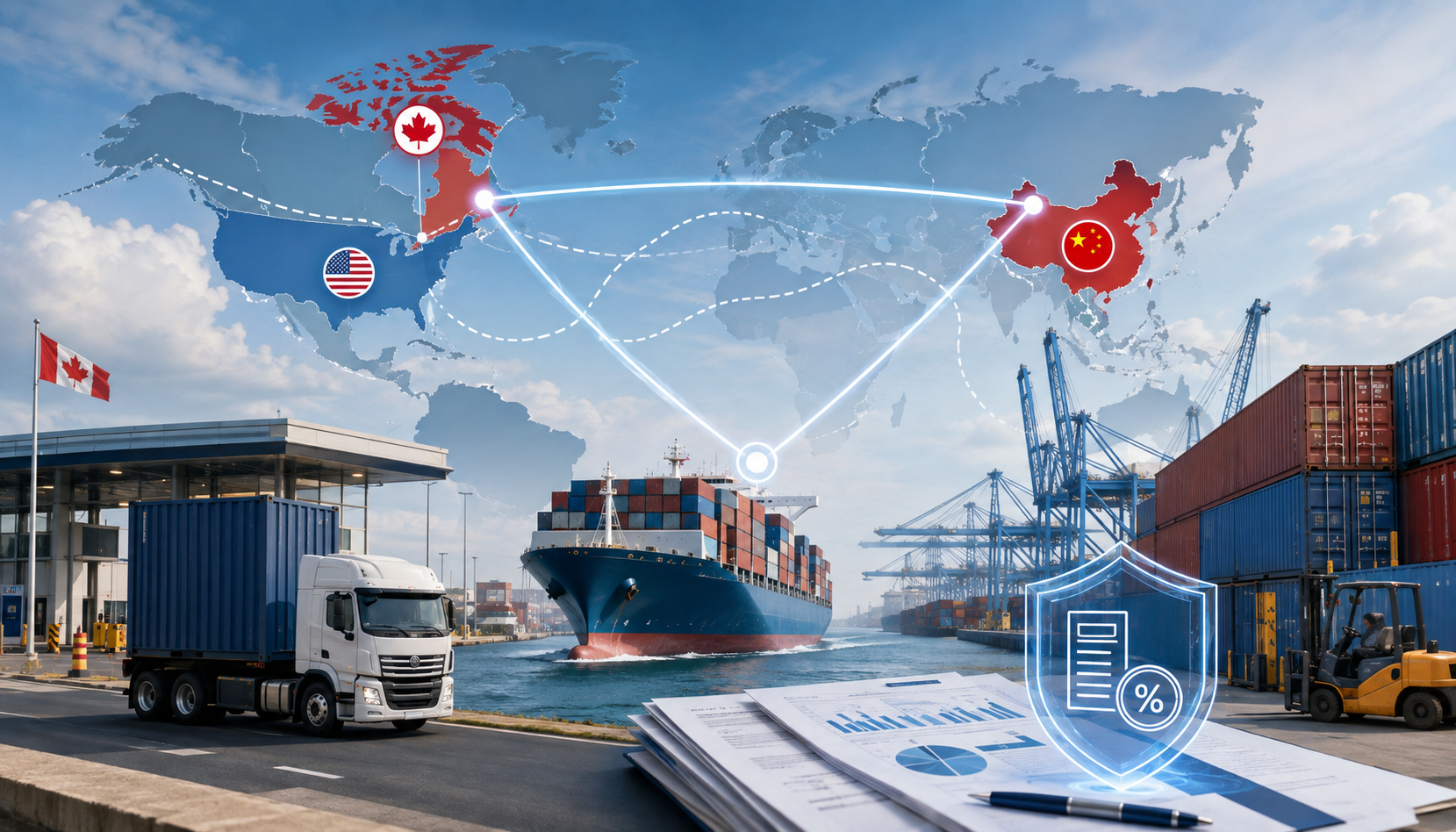
Tariffs Are Redesigning the Supply Chain
For many years, companies treated tariffs as a calculation made after transportation decisions had already been made. A product was purchased, a route was selected, and customs duties were added near the end of the process.
That approach is becoming increasingly risky.
The latest changes in United States, Canadian, and Chinese trade policy show that tariffs are no longer simply a line on a customs entry. They are influencing where products are manufactured, where inventory is stored, how cross-border e-commerce orders are fulfilled, and even whether a shipment should move through the United States or Canada at all.
The most important lesson is simple: a logistics route can change where a shipment travels, but it does not automatically change where the product legally originates.
The New U.S.–Canada Reality
The United States and Canada still have one of the world's most integrated trading relationships. Approximately US$2.5 billion in goods and services crosses the border each day, and the United States–Mexico–Canada Agreement remains in force while the parties continue the 2026 joint review process.
However, free trade treatment can no longer be assumed merely because a shipment moves between two North American countries.
In July 2026, the United States announced new 50 percent tariffs on nearly $20 billion of selected Canadian imports. The measures cover specified products connected to the automotive, alcoholic beverage, dairy, and related sectors. For covered goods, USMCA origin alone may not eliminate the additional tariff.
Canada has removed many of the broad counter-tariffs introduced in 2025, but it continues to maintain measures on certain U.S. steel, aluminum, and automobiles. Canada also applies special measures to selected Chinese electric vehicles, steel, aluminum, and products containing steel melted and poured—or aluminum smelt and cast—in China.
This creates a far more complicated environment than a simple question of which country has the lower tariff.
Canada Is Not a Tariff Back Door
When U.S. tariffs on Chinese goods rise, some companies immediately consider shipping the goods to Canada first. The theory is that the product can be stored, repacked, relabeled, or shipped through a Canadian warehouse before entering the United States.
But a change in shipping route is not the same as a change in country of origin.
Simple storage, sorting, repacking, labeling, or order fulfillment in Canada will generally not transform a Chinese product into a Canadian-origin product. Customs authorities can examine the location of actual manufacturing, the nature of the processing, the source of key components, and—in the case of metals—even where the steel was melted and poured or the aluminum was smelt and cast.
Businesses attempting to use Canada only as a transshipment point may therefore face more than an unexpected duty bill. They may also face shipment holds, requests for production records, origin verification, penalties, or allegations of tariff circumvention.
Canada can be an important logistics market. But it should not be treated as a label-changing station.
Canada Still Has Strategic Logistics Value
Rejecting tariff circumvention does not mean rejecting Canada as a supply-chain location. Canada can still play an important role when it is used for a legitimate commercial purpose.
A company may establish Canadian inventory to serve Canadian customers, reduce domestic Canadian delivery times, manage Canadian returns, or support local wholesale distribution. Certain businesses may perform meaningful manufacturing or processing in Canada that qualifies under the applicable origin rules. Others may use duty-relief, drawback, bonded, or re-export programs when the legal requirements are met.
The better strategy is often not China to Canada to avoid the United States tariff. It is:
- China to a U.S. inventory pool for U.S. customers;
- China to a Canadian inventory pool for Canadian customers; and
- Cross-border movement only when the landed cost, origin rules, and customer requirements support it.
This is network design, not tariff avoidance.
The Impact on Transportation
Tariff volatility does not necessarily eliminate freight. It redirects freight.
Cross-border truckload and less-than-truckload volumes may become less predictable as importers change suppliers and inventory locations. Companies may shift from large seasonal purchases to smaller and more frequent replenishment orders. Some commodities may move through different ports, while others may be held longer in bonded facilities as importers wait for documentation or policy clarification.
Transportation providers will also need better shipment data. A carrier may not determine the tariff classification, but incomplete product descriptions, inconsistent country-of-origin information, or missing metal-content details can delay a border crossing. Freight quotes that include only linehaul may also become misleading when brokerage, disbursement fees, customs examinations, storage, duties, and return costs materially affect the final landed cost.
The lowest freight rate may no longer produce the lowest total supply-chain cost.
The Impact on Cross-Border E-Commerce
The pressure is particularly strong in e-commerce.
The United States has suspended duty-free de minimis treatment for low-value shipments worldwide. A business model built around sending thousands of inexpensive parcels directly to American consumers must now account for duties, customs processing, data requirements, carrier collection fees, and the customer experience when charges are not prepaid.
- More sellers will compare parcel injection with bulk commercial importation and domestic fulfillment.
- Low-margin and high-return products may no longer be viable for international direct shipping.
- Sellers will need to calculate landed cost before the customer places the order.
- DDP solutions will become more valuable, but only when tariff classification and origin data are reliable.
- U.S. and Canadian returns may need to be handled in separate domestic facilities.
- E-commerce platforms will demand better product-level compliance data from sellers.
The competitive advantage in cross-border e-commerce is moving away from who has the cheapest international postage toward who can calculate, collect, and manage the full landed cost before checkout.
What Importers Should Do Now
- Confirm the correct tariff classification.
- Determine the legal country of origin—not merely the country of shipment.
- Check whether Section 232, Section 301, Section 338, reciprocal tariffs, Canadian surtaxes, or another measure applies.
- Determine whether any Canadian processing is sufficient to change origin under the applicable rule.
- Decide whether U.S. and Canadian inventory should be separated based on customer market and total landed cost.
These decisions should be reviewed with qualified customs and legal professionals when necessary. A forwarder, carrier, warehouse, customs broker, importer, and e-commerce platform may each hold only one part of the information. The risk appears when those parts do not connect.
The Bottom Line
The current tariff environment is doing more than raising import costs. It is forcing companies to redesign their supply chains around origin, product data, inventory placement, customs strategy, and customer location.
Canada remains a valuable market and logistics location, but it is not an automatic back door for Chinese goods entering the United States. The companies that adapt successfully will not be the ones that simply search for a new route around a tariff. They will be the ones that build a supply chain in which the product, documents, origin, inventory, transportation, and final customer all tell the same story.
Tariffs do not simply stop freight. They redirect freight—and make every shipment more dependent on accurate data.
Editorial note: This article provides general supply-chain information and is not legal or customs advice. Tariff treatment depends on the product, classification, origin, entry date, and applicable exclusions or relief.