
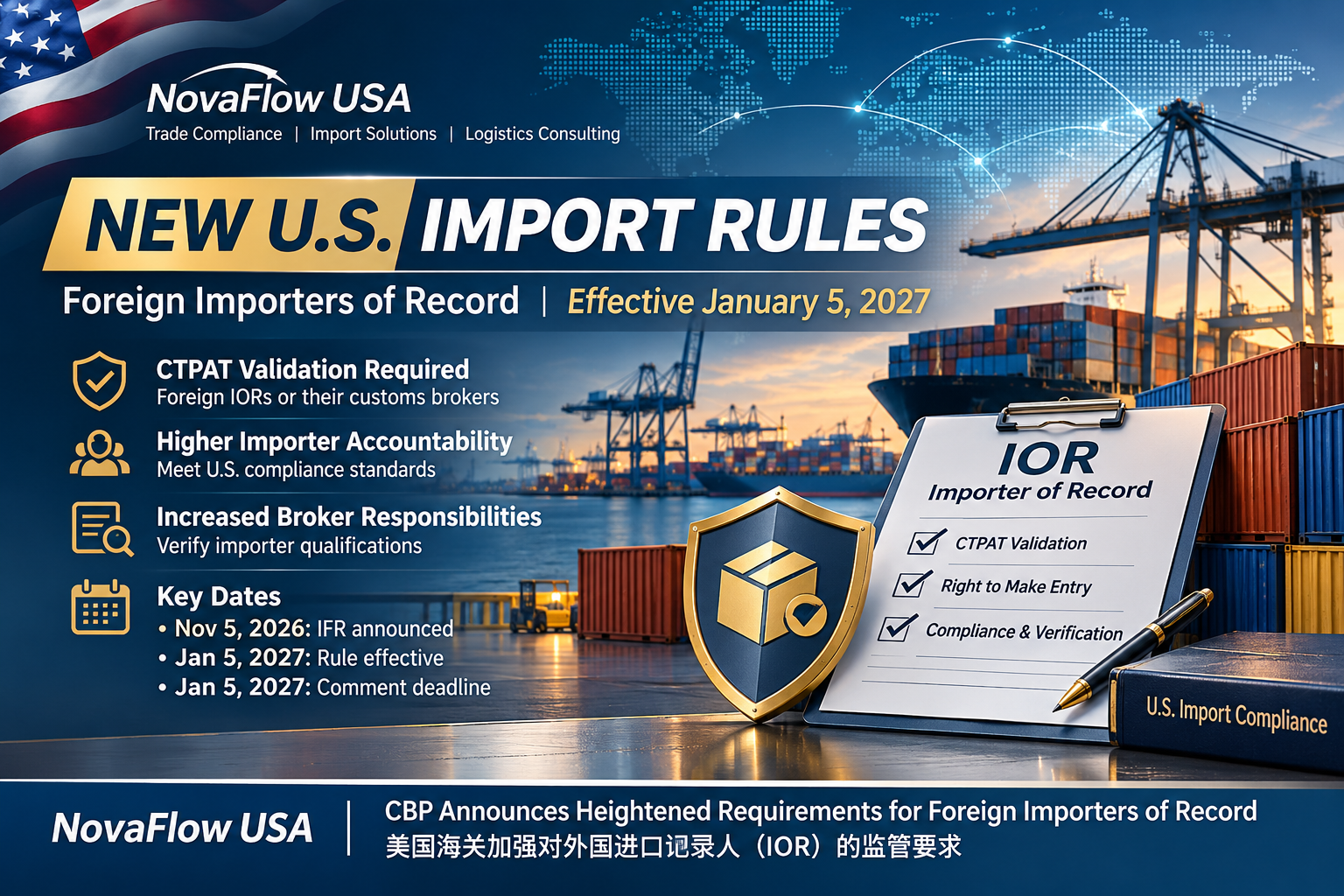
CBP Announces Heightened Requirements for Foreign Importers of Record
Published: November 6, 2026
Effective Date: January 5, 2027
Introduction
On November 5, 2026, U.S. Customs and Border Protection (CBP) announced an Interim Final Rule (IFR) establishing heightened requirements for foreign Importers of Record (IORs).
The rule, published in the Federal Register on November 6, 2026, is scheduled to become effective on January 5, 2027.
The new regulatory framework strengthens importer accountability, CTPAT validation requirements, customs broker responsibilities, and importer verification procedures.
These changes are particularly important for foreign manufacturers, cross-border e-commerce sellers, trading companies, customs brokers, and international logistics providers.
1. New CTPAT Requirements for Foreign IORs
Under the new rule, foreign Importers of Record must satisfy additional requirements when filing covered consumption entries into the United States.
Option 1: CTPAT-Validated Foreign IOR
A foreign IOR that has obtained CTPAT validation may make entry when it possesses the legal right to make entry and satisfies other applicable customs requirements.
Option 2: CTPAT-Validated Licensed Customs Broker
A foreign IOR without CTPAT validation may use a CTPAT-validated U.S. licensed customs broker, subject to the applicable regulatory conditions.
The broker may make entry or serve as the IOR where required by the rule and the underlying transaction.
Using a CTPAT-validated customs broker does not automatically grant CTPAT membership or benefits to the foreign importer.
The new requirements apply to covered formal consumption entries and specified informal consumption entries requiring CBP Form 3461 and/or Form 7501. They do not constitute a blanket prohibition on all informal entries by foreign importers.
2. U.S. Company Registration Does Not Automatically Establish U.S. IOR Status
A significant provision of the rule concerns the qualification of a U.S. Importer of Record under 19 CFR 110.2.
For business entities, the regulation considers U.S. organization and location, beneficial ownership, control, and qualifying U.S. real property ownership.
One qualification pathway generally involves at least 51 percent beneficial ownership and control by U.S. citizens or lawful permanent residents. Another involves qualifying significant U.S. real property directly owned without encumbrances.
CBP may also consider the entity's actual operations, physical business presence, employees, assets, capitalization, revenue, profitability, and independence from foreign manufacturers.
Simply registering an LLC or corporation in the United States, obtaining an EIN, or maintaining a U.S. mailing address does not automatically establish U.S. IOR eligibility.
3. Increased Responsibilities for Customs Brokers
Licensed customs brokers face additional responsibilities for verifying the qualifications of clients declared as U.S. Importers of Record.
Relevant documentation may include:
- Corporate formation and registration records.
- Beneficial ownership and control information.
- Business address and operational documentation.
- Financial statements and supporting asset records.
- Purchase agreements, invoices, and transaction records.
- Other documents demonstrating importer eligibility.
The rule also introduces changes to importer declarations associated with CBP Forms 3461 and 7501 and their electronic equivalents.
Customs brokers should review applicable verification, documentation, and recordkeeping requirements before the effective date.
4. Right to Make Entry Remains Essential
CTPAT validation and U.S. IOR classification do not replace the statutory Right to Make Entry requirement.
Under 19 U.S.C. 1484, entry must be made by a party legally entitled to make entry, including an owner, purchaser, or another qualifying party under applicable customs law.
A U.S. corporation cannot automatically serve as IOR for unrelated foreign merchandise merely by providing its EIN, importer number, customs bond, or company name.
Businesses should examine the underlying commercial transactions, purchasing arrangements, ownership rights, and contractual responsibilities.
5. Impact on International Trade and E-Commerce
Foreign Manufacturers: Manufacturers exporting directly to the United States should review whether their existing foreign IOR arrangements satisfy the new CTPAT requirements.
Cross-Border E-Commerce Sellers: Foreign sellers using U.S. fulfillment centers should verify their importer classification and customs broker arrangements.
U.S. Trading Companies: Companies acting as importers should maintain genuine commercial operations and appropriate documentation supporting their right to make entry.
B2B Marketplaces: Platforms connecting foreign suppliers with U.S. buyers should clearly define which party serves as the importer and assumes customs responsibilities.
Customs Brokers and Logistics Providers: Service providers should review customer verification procedures and applicable CTPAT requirements.
6. Important Dates
- November 5, 2026: CBP announces the Interim Final Rule.
- November 6, 2026: Publication in the Federal Register.
- January 5, 2027: Effective date of the new rule.
- January 5, 2027: Public comment deadline, Docket USCBP-2026-1387.
- May 6, 2027: Final compliance deadline under the customs broker delayed-compliance framework, subject to the rule's conditions.
7. Recommended Compliance Actions
- Determine whether the importer qualifies as a U.S. IOR or foreign IOR.
- Verify the customs broker's CTPAT validation status.
- Confirm the importer's legal Right to Make Entry.
- Review CBP Form 5106, customs bonds, and Powers of Attorney.
- Evaluate corporate ownership, control, and actual U.S. business operations.
- Review commercial invoices, purchasing agreements, and supporting documentation.
- Consult qualified customs professionals where necessary.
Conclusion
The new CBP requirements represent a significant development in U.S. customs enforcement and foreign importer accountability.
Foreign manufacturers, e-commerce sellers, trading companies, and logistics providers should evaluate their importer structures and customs compliance procedures before January 5, 2027.
Early preparation may help reduce the risk of customs clearance disruptions and regulatory noncompliance.
Official References
Federal Register — Heightened Requirements for Foreign Importers of Record
CBP — Strengthening Customs Enforcement
NovaFlow USA
U.S. Customs Compliance | Import Solutions | Logistics Consulting
www.novaflowusa.com
Disclaimer: This article is provided for general informational purposes only and does not constitute legal, customs, or tax advice. Consult qualified professionals regarding specific transactions.