
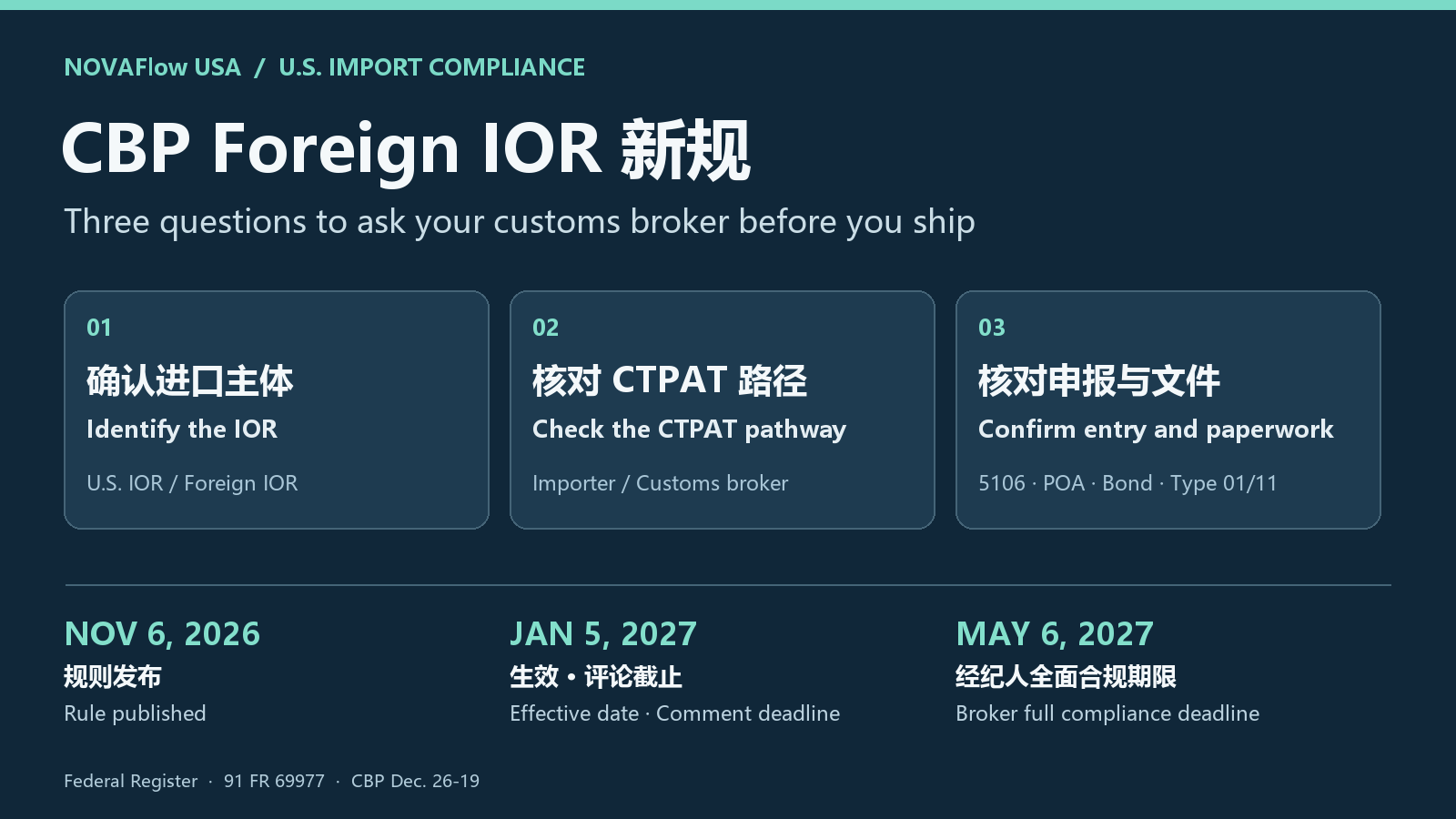
A U.S. warehouse may receive a shipment, a broker may transmit the entry, and an overseas seller may own the goods. Those can be three different parties. Before the shipment leaves, establish which legal entity will appear as the Importer of Record (IOR), whether it has the right to make entry, and who will provide the records supporting the declaration.
What changes on January 5, 2027?
U.S. Customs and Border Protection (CBP) published its interim final rule on November 6, 2026. It takes effect on January 5, 2027, which is also the public comment deadline. May 6, 2027 is the full compliance deadline for customs brokers. A limited delay approved by CBP applies to the broker’s U.S. IOR verification requirement under 19 CFR § 111.29. For shipment planning, use January 5 as the effective date and confirm any approved verification delay with your broker.
Under 19 CFR § 141.21, the Foreign IOR requirements cover formal consumption entries and informal consumption entries that require CBP Form 3461 or 7501, including electronic equivalents. For a shipment proposed as Type 01 (T01) or Type 11 (T11), give the broker the product details and planned entry date. Ask the broker to confirm the entry type and whether that specific entry falls within the rule.
A U.S. company should check its IOR qualification before declaring it
Under 19 CFR § 110.2, an entity must be organized under U.S. law and located in the United States. In addition, it must satisfy either the rule’s 51% beneficial ownership and control requirement involving U.S. citizens or lawful permanent residents, or the alternative requiring continuous direct ownership of a significant amount of unencumbered U.S. real property. CBP may look at where substantial business is conducted, the company’s operations and assets, and its capitalization.
For example, a newly formed U.S. LLC with a warehouse mailing address should give its broker the formation documents, ownership and control records, and evidence of actual U.S. operations. Ask which additional records the broker needs before making a U.S. IOR declaration. If ownership or control changes, revisit the qualification before the next filing.
Two CTPAT pathways for Foreign IORs
- The Foreign IOR is CTPAT-validated. If it also has the right to make entry, it may enter the covered merchandise itself or hire a licensed customs broker.
- The Foreign IOR lacks CTPAT validation. For a covered entry, it must designate a licensed customs broker that is CTPAT-validated. Ask whether the broker will file on the importer’s behalf or act as the IOR, and have the broker review who owns or purchased the merchandise and who will sign the POA.
CBP also announced new fields on Forms 3461 and 7501 and their electronic equivalents. The fields address U.S. IOR status, whether a broker is acting on behalf of a principal as both filer and IOR, and the identity of the principal on the POA when applicable. Confirm who will supply and verify each applicable field before filing.
What to send the broker before booking
- Importer identity and authority. Send the legal name, importer number if available, and the parties shown on the commercial invoice and transport documents. Ask whether CBP Form 5106 needs to be created or updated and who is authorized to sign the power of attorney (POA).
- Product and entry details. Share a specific product description, country of origin, value, and planned port and entry date. Ask the broker to review the classification and the proposed Type 01 or Type 11 entry, and identify any FDA or CPSC requirements for the product.
- Bond and billing. Confirm which entity and bond will be used where required. Get written confirmation of who pays duties, taxes, brokerage charges, and any examination or storage charges under your arrangement.
- Written confirmation. Keep the broker’s answer with the shipment file. Record the IOR, the applicable CTPAT pathway, outstanding documents, and the person responsible for each open item.
If a shipment is held or selected for examination
Ask the broker to identify the agency and the exact status of the shipment. Record the port, entry number, shipment reference, notice, documents requested, and response deadline. Assign a contact to send the documents and follow up. Before dispatching a pickup truck, confirm customs release and separately check with the cargo facility that the freight is available for pickup.
A practical example. A seller plans to ship to a U.S. fulfillment warehouse in February 2027 and expects to use an overseas company as the IOR. Before booking, the seller sends the broker the commercial invoice, the legal name of the overseas entity and the product details. The broker confirms whether the planned entry is covered, which CTPAT pathway applies, and whose importer number, POA and bond will be used where required. The warehouse confirms its receiving role and the contact for any hold. The parties now have a written record they can use for the next shipment.
Official sources. Federal Register, 91 FR 69977 · CBP CSMS #70381183