
Introduction
When an imported shipment encounters a problem during customs clearance, the importer may hear terms such as Hold, Detention, Exclusion, and Seizure.
These terms are sometimes used as though they mean the same thing. In reality, they describe different types or stages of government action and may lead to very different consequences.
A shipment placed on Hold has not necessarily been found to violate any law. A detained shipment has not necessarily been seized. An excluded shipment may still be eligible for re-exportation, while seized merchandise is generally subject to a more serious enforcement process.
Understanding the shipment's actual status is important because the correct response, available options, deadlines, and potential costs depend on the procedural stage.
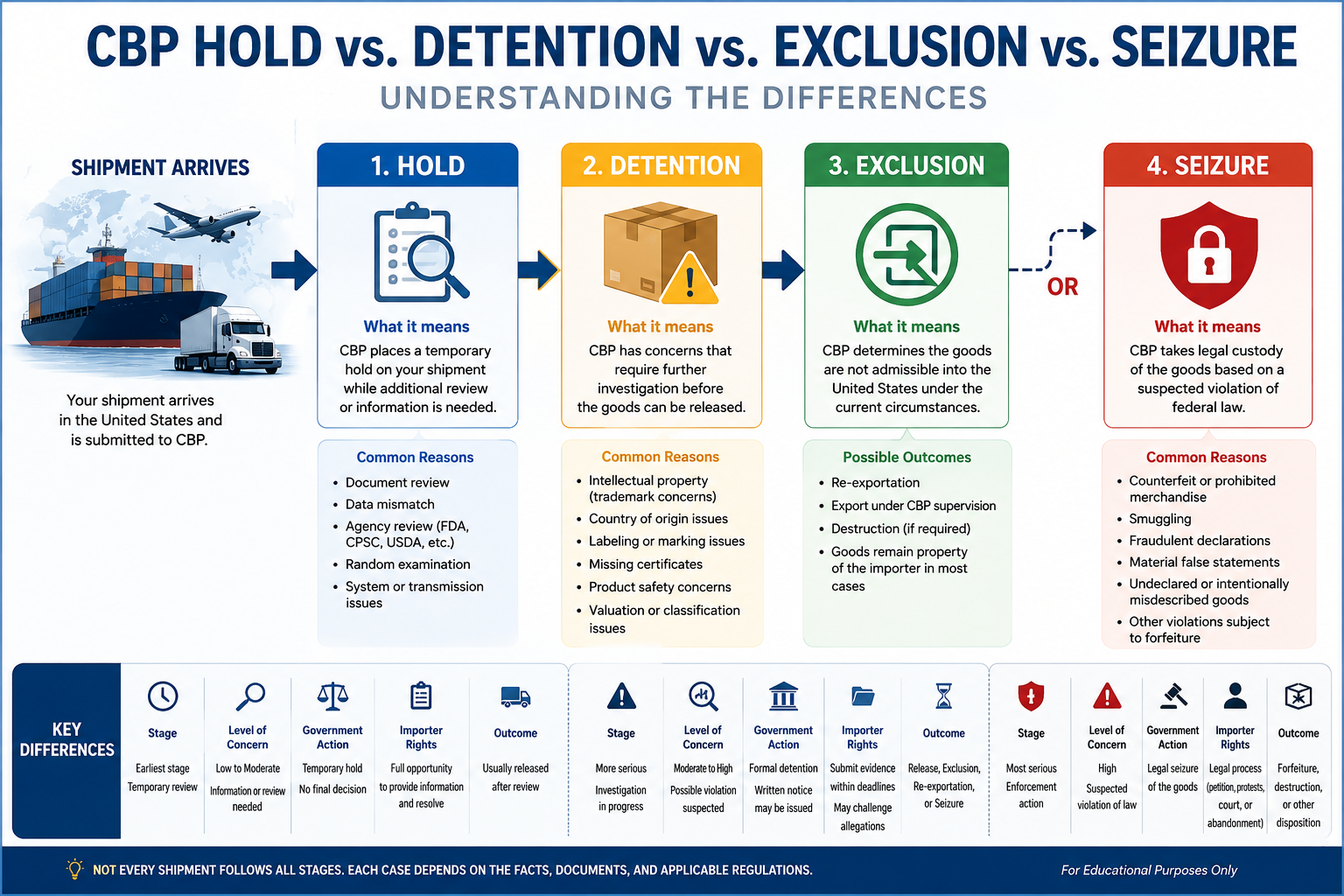
Illustration only — CBP Hold, Detention, Exclusion, and Seizure are different actions and do not always occur in a fixed sequence.
1. What Is a CBP Hold?
A Hold is generally a temporary restriction preventing cargo from being released or moved while CBP or another government agency completes a review.
A Hold does not automatically mean the merchandise is illegal, inadmissible, or subject to enforcement action. In many cases, the government is reviewing information, waiting for documents, coordinating with another agency, or deciding whether an examination is necessary.
Common reasons for a Hold may include:
- Manifest or entry data review
- Missing or inconsistent shipment information
- Document verification
- Selection for physical examination
- FDA, CPSC, USDA, EPA, or another agency review
- Questions concerning value, classification, origin, or parties to the transaction
- System or transmission issues affecting the visibility of required data
Some Holds are resolved quickly after information is corrected or supporting documents are submitted. Others may lead to an examination or a more formal action if a compliance issue is identified.
2. What Is an Examination?
An examination is the physical, documentary, or electronic review of a shipment. CBP may examine selected cartons, review the entire shipment, inspect labels and markings, or request documents supporting the entry.
An examination is not necessarily a finding of wrongdoing. Shipments may be selected based on risk analysis, routine compliance verification, commodity concerns, agency requirements, or other operational considerations.
However, if the examination identifies a possible violation, the shipment may remain on Hold or proceed to Detention, Exclusion, Seizure, or another agency action.
3. What Is Detention?
Detention is more formal and generally more serious than an ordinary Hold. It means CBP is retaining the merchandise while determining whether it is admissible into the United States.
CBP may issue a written detention notice explaining the reason for the action and identifying information or evidence that may be submitted. Depending on the issue, the importer may need to provide product records, authorization documents, certificates, testing reports, purchase records, photographs, or explanations of the transaction.
Common reasons for Detention may include:
- Suspected trademark or intellectual property violations
- Questions concerning country-of-origin markings
- Product labeling or packaging concerns
- Missing permits, certificates, or supporting documents
- Product safety or other agency requirements
- Possible valuation, classification, or admissibility issues
- Differences between the declared merchandise and the merchandise examined
Detention does not automatically mean that CBP has made a final decision. The importer may still have an opportunity to submit evidence and explain why the merchandise should be admitted.
Deadlines are important. The importer should obtain the actual written notice, determine what information is requested, and coordinate a complete and timely response through the customs broker and qualified counsel when appropriate.
4. What Is Exclusion?
Exclusion generally means that CBP has determined that the merchandise cannot be entered into the United States under the applicable entry and current circumstances.
In other words, the goods are not being released into U.S. commerce. This may occur after a detention review, after the importer fails to provide sufficient evidence, or when the merchandise does not satisfy an applicable admissibility requirement.
Possible reasons for Exclusion may include:
- Failure to comply with an applicable regulatory requirement
- Missing or unacceptable certificates or approvals
- Inadequate evidence submitted during detention
- Product labeling, marking, or safety deficiencies
- Merchandise determined to be inadmissible by another government agency
- Failure to satisfy conditions required for entry
Exclusion is not automatically the same as Seizure. In many exclusion cases, the importer may retain ownership of the merchandise and may be required or permitted to arrange re-exportation, supervised exportation, or another authorized disposition.
The actual options depend on the reason for exclusion and the instructions provided by CBP or the participating government agency.
5. What Does Inadmissible Mean?
When merchandise is described as inadmissible, it means the goods do not qualify to enter the United States under the applicable requirements or current circumstances.
An inadmissibility determination may result in Exclusion, re-exportation, destruction, or another required disposition. The importer should not assume that the cargo can simply be picked up or moved because a transportation authorization has been issued.
The cargo may remain under CBP Hold until all required export or disposition procedures have been completed and properly reflected in the relevant systems.
6. What Is Re-Exportation?
Re-exportation means the merchandise is exported from the United States rather than entered into U.S. commerce.
A re-export process may involve coordination among:
- The importer
- The customs broker
- The airline or ocean carrier
- The cargo terminal or examination station
- CBP
- Another government agency, when applicable
Before the cargo can depart, required export information, transportation documents, authorizations, and system messages may need to be transmitted and accepted.
A message that has been prepared is not necessarily the same as a message that has been successfully transmitted, accepted, and matched to the correct shipment. When CBP states that it cannot see a required transmission, the responsible party should verify the transmission status and obtain the applicable system acknowledgment or confirmation.
7. What Is Seizure?
Seizure is one of the most serious enforcement actions CBP can take against imported merchandise.
In a Seizure, CBP exercises legal authority over the goods based on a suspected violation of federal law. The merchandise is not merely waiting for routine review or export arrangements.
Situations that may lead to Seizure include:
- Counterfeit or prohibited merchandise
- Smuggling or concealment
- Fraudulent documents or declarations
- Material false statements
- Undeclared or intentionally misdescribed merchandise
- Other suspected violations subject to forfeiture
CBP generally issues formal notice describing the seizure and available procedures. Depending on the circumstances, interested parties may have options involving a petition, administrative proceedings, judicial proceedings, abandonment, or other action.
Because legal rights and strict deadlines may be involved, seizure matters should be reviewed promptly with qualified customs counsel.
8. Exclusion and Seizure Are Not the Same
The distinction between Exclusion and Seizure is especially important.
- Exclusion: The merchandise is not permitted to enter under the applicable entry. Re-exportation or another disposition may be available.
- Seizure: CBP has taken enforcement custody of the merchandise based on a suspected legal violation.
An excluded shipment may remain the importer's property, subject to CBP control and disposition requirements. A seized shipment is involved in an enforcement and potential forfeiture process.
The phrase “customs rejected the shipment” is not sufficiently precise. Importers should determine whether the cargo is on Hold, under examination, detained, excluded, seized, or awaiting a specific export procedure.
9. Do These Actions Always Follow the Same Sequence?
No. Hold, Detention, Exclusion, and Seizure should not be understood as an automatic four-step sequence.
A shipment may be placed on Hold and then released. Another shipment may move from Hold to examination and Detention. A detained shipment may eventually be released, excluded, or seized, depending on the facts.
CBP may also seize merchandise without first completing every other stage if the circumstances support immediate enforcement action.
A simplified illustration may look like this:
Shipment Arrives
↓
Hold or Examination
↓
Release, Detention, or Other Agency Action
↓
Possible Exclusion and Re-Exportation
or
Possible Seizure
10. Common Misunderstandings
“A Hold means the shipment has been rejected.”
Not necessarily. A Hold may only mean that additional review is pending.
“A Detention means CBP has already seized the merchandise.”
No. Detention and Seizure are different actions. A detained shipment may still be released if the importer provides satisfactory evidence.
“An excluded shipment can never leave the warehouse.”
Not necessarily. Excluded or inadmissible merchandise may be eligible or required to be re-exported under CBP supervision, but the required procedures must be completed first.
“Changing airports or ports will solve the problem.”
Changing the port of entry does not correct an underlying issue involving product safety, intellectual property, origin, valuation, documentation, or admissibility.
“The system problem means nothing needs to be done.”
A system issue may explain why CBP cannot see a transmission, but the filer should still verify that the message was successfully transmitted and obtain the relevant acknowledgment.
11. What Should an Importer Do?
When cargo is held or subject to enforcement action, the importer should proceed carefully:
- Obtain the official CBP or agency notice.
- Confirm the exact status of the shipment.
- Identify the reason for the action.
- Review the entry data and supporting documents.
- Confirm whether any required system transmission was accepted.
- Compare the examined merchandise with the invoice and declarations.
- Coordinate with the customs broker, carrier, warehouse, and government agency.
- Track all response, petition, export, and storage deadlines.
- Consult qualified customs counsel when the matter involves detention, exclusion, seizure, penalties, or significant financial exposure.
Importers should not rely solely on informal statements such as “customs has the shipment” or “the system is down.” The written notice and transmission records are usually the best starting points.
12. Storage and Operational Costs Can Continue
While the shipment remains on Hold, under Detention, or awaiting re-exportation, storage, handling, examination, trucking, airline, terminal, or demurrage-related charges may continue to accumulate.
Even when the government action cannot be resolved immediately, the importer should monitor operational costs and confirm who is responsible for each required step.
Delays can become expensive when the importer assumes that the broker, carrier, warehouse, or government agency is handling the next action without receiving written confirmation.
Conclusion
CBP Hold, Detention, Exclusion, and Seizure are not interchangeable terms.
A Hold may be a temporary review. Detention involves a formal admissibility concern. Exclusion means that the goods cannot enter under the applicable circumstances and may need to be re-exported. Seizure is a more serious enforcement action involving suspected legal violations.
The first question should therefore not simply be, “Why is customs holding my cargo?” Instead, the importer should ask:
What is the exact procedural status, what notice was issued, what action is required, and what is the deadline?
Accurate information, timely responses, complete documentation, and effective coordination among the importer, customs broker, carrier, warehouse, and professional advisers can significantly improve the handling of a customs problem.
This article is provided for general educational and industry-information purposes only. It does not constitute legal advice. Importers should consult their customs broker or qualified customs counsel regarding a specific shipment.