
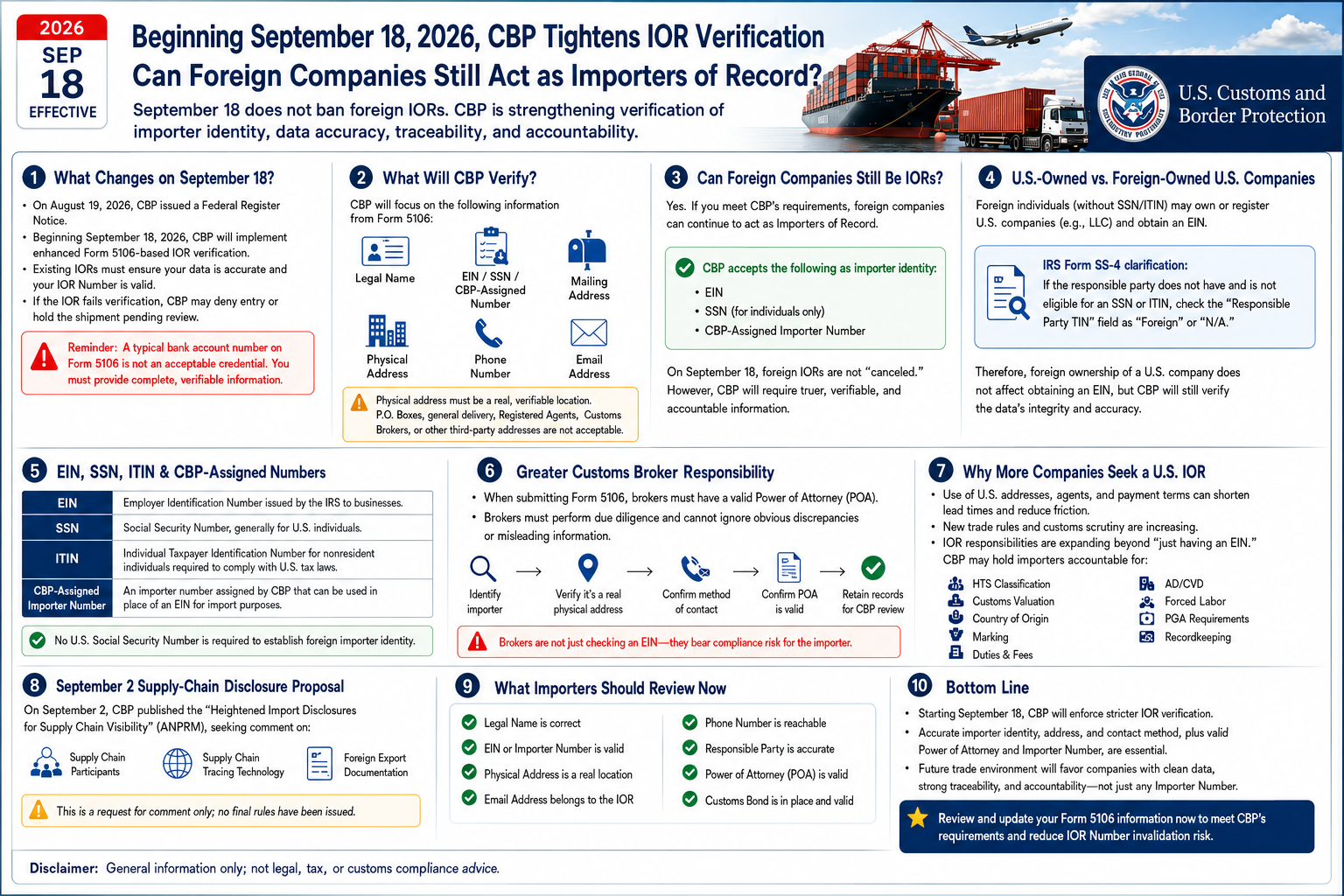
September 18, 2026: A Major IOR Compliance Date
Beginning September 18, 2026, U.S. Customs and Border Protection (CBP) will strengthen enforcement of Importer of Record (IOR) identity information submitted through CBP Form 5106.
This development has generated considerable discussion in the international trade and cross-border logistics community. One of the most common questions is:
Does this mean foreign companies will no longer be allowed to act as Importers of Record in the United States?
1. What Changes on September 18?
On August 19, 2026, CBP published a Federal Register notice titled Accuracy of Importer of Record Data Submitted to CBP.
Beginning September 18, 2026, if CBP determines that information provided by an Importer of Record, or by a customs broker acting on the importer's behalf, is incomplete or inaccurate, CBP may immediately void the associated IOR number.
Once an IOR number is voided, it becomes invalid for Customs purposes, including making entry of imported merchandise into the United States, until the importer number is properly reestablished.
This means Form 5106 should no longer be treated as merely a routine administrative form. Importer identity information is becoming an increasingly important Customs compliance issue.
2. What Information Will CBP Examine?
CBP Form 5106 contains core importer identification information, including:
- Legal importer name;
- EIN, SSN, or CBP-assigned importer number;
- Mailing address;
- Physical business address;
- Telephone number; and
- Email address.
CBP has emphasized that importer identity information must be accurate, complete, current, and directly associated with the Importer of Record.
Physical Address Is Particularly Important
The physical address should represent an actual physical location associated with the business or individual.
Importers should be especially careful about using addresses belonging only to a registered agent, customs broker, freight forwarder, P.O. Box, business service center, or another unrelated person or company.
The telephone number and email address submitted to CBP should likewise properly identify and reach the Importer of Record rather than simply directing CBP to an unrelated intermediary.
3. Can Foreign Companies Still Act as Importers of Record?
Yes, under appropriate circumstances.
The September 18 enforcement action does not establish a blanket rule prohibiting foreign companies from acting as Importers of Record.
CBP continues to recognize different forms of importer identification, including EINs, SSNs for individuals, and CBP-assigned importer numbers in appropriate situations.
The more accurate interpretation of the new enforcement environment is:
CBP wants to know who the Importer of Record really is and whether that importer is real, properly identified, reachable, verifiable, and accountable.
4. U.S.-Owned Company vs. Foreign-Owned U.S. Company
Another common misunderstanding concerns Employer Identification Numbers.
Consider two examples:
Company A: A U.S. LLC owned by a U.S. citizen.
Company B: A U.S. LLC owned entirely by a Chinese citizen who does not have a U.S. Social Security Number.
Both companies may generally obtain an IRS Employer Identification Number (EIN), assuming the applicable IRS requirements are satisfied.
IRS Form SS-4 instructions provide that when the responsible party does not have, and is not eligible to obtain, an SSN or ITIN, the applicant may enter foreign or N/A on the applicable responsible-party taxpayer identification line.
Therefore, foreign ownership by itself does not mean that a U.S.-formed entity cannot obtain an EIN.
Likewise, U.S. citizenship by itself does not automatically make one company a more legitimate Importer of Record than another.
The actual legal entity, importer identity, transaction structure, business activity, bond, Power of Attorney, product compliance, and Customs responsibilities remain important.
5. EIN, SSN, ITIN and CBP-Assigned Importer Number
EIN — Employer Identification Number
An EIN is issued by the Internal Revenue Service to identify businesses and certain other entities for federal tax purposes.
SSN — Social Security Number
An SSN generally identifies an eligible individual.
ITIN — Individual Taxpayer Identification Number
An ITIN is an IRS tax-processing number for certain individuals who require a U.S. taxpayer identification number but are not eligible for an SSN.
CBP-Assigned Importer Number
CBP may assign an importer identification number in appropriate circumstances when the importer does not use an EIN or SSN.
Therefore, the absence of a U.S. Social Security Number does not by itself mean that a foreign company cannot establish a legitimate Customs importer identity.
6. Customs Brokers Also Face Greater Responsibility
The September 18 initiative is important not only for importers but also for licensed customs brokers.
When a customs broker submits Form 5106 on behalf of an importer, the broker must have appropriate authority from the Importer of Record, including a valid Power of Attorney where required.
Customs brokers also have due-diligence responsibilities and should not knowingly transmit false, misleading, incomplete, or improperly verified importer identity information.
As a result, importer onboarding may increasingly require more than simply asking a customer for an EIN.
A broker may need to understand:
- Who is the actual importer?
- Where is the importer physically located?
- Does the phone number belong to the importer?
- Does the email address belong to the importer?
- Who signed the Power of Attorney?
- Is the importer information supportable if CBP reviews it?
7. Why Are More Foreign Companies Looking for a U.S. IOR?
The stronger verification environment may help explain why more foreign manufacturers, e-commerce sellers, logistics companies, and freight forwarders are evaluating U.S.-based IOR arrangements.
Historically, some cross-border structures relied heavily on third-party addresses, registered-agent addresses, freight-forwarder contact information, broker contact information, or importer records that were not routinely updated.
Those arrangements may now receive greater scrutiny.
The IOR may assume substantial Customs compliance responsibilities, including:
- HTS classification;
- Customs valuation;
- Country of origin;
- Country-of-origin marking;
- Customs duties and fees;
- Antidumping and countervailing duties;
- Forced-labor compliance;
- Partner Government Agency requirements;
- Intellectual-property requirements; and
- Customs recordkeeping.
A U.S. company considering acting as IOR for another party should therefore understand the transaction, the merchandise, and the associated compliance exposure before accepting that responsibility.
8. September 2: Another Important Supply-Chain Development
On September 2, 2026, CBP published an Advance Notice of Proposed Rulemaking concerning Heightened Import Disclosures for Supply Chain Visibility.
CBP is considering future requirements involving additional information about supply-chain participants, supply-chain tracing technology, and foreign export documentation.
This is currently a proposal and comment process, not a final rule already in effect.
Nevertheless, when considered together with the September 18 Form 5106 enforcement initiative, the direction is increasingly clear:
CBP wants greater visibility into the real parties behind merchandise entering the United States.
9. What Should Importers Review Now?
Importers should consider reviewing their existing Form 5106 and related Customs information, including:
- Legal name;
- EIN or importer number;
- Physical address;
- Mailing address;
- Email address;
- Telephone number;
- Responsible-party information;
- Power of Attorney;
- Customs bond information; and
- Whether the importer structure still reflects the actual business operation.
Foreign importers should also review whether their nonresident IOR arrangement remains appropriate for their current U.S. import activity.
10. The Bigger Picture for Cross-Border Trade
The important change may not simply be another Customs filing requirement.
U.S. import compliance appears to be moving away from a model in which having an importer number was sometimes treated as sufficient, toward a model in which CBP increasingly wants to understand the real party behind that number.
This development is particularly relevant to Chinese manufacturers, foreign e-commerce sellers, Amazon and Walmart sellers, DDP logistics providers, freight forwarders, and customs brokers.
Bottom Line
September 18, 2026 does not mean that foreign companies can no longer act as Importers of Record.
The more accurate conclusion is:
CBP is moving toward stricter verification of who the Importer of Record really is and whether that importer is identifiable, verifiable, reachable, and accountable.
For foreign manufacturers and e-commerce sellers planning long-term access to the U.S. market, obtaining an importer number alone may no longer be enough.
A more sustainable approach may require a properly structured combination of U.S. import compliance, IOR planning, customs brokerage, transportation, warehousing, and fulfillment.
Disclaimer: This article is provided for general informational purposes only and does not constitute legal, tax, or Customs compliance advice. Companies should evaluate their individual circumstances with a licensed customs broker, customs attorney, or qualified tax professional.