
For many years, foreign companies have been able to participate directly in U.S. import transactions as Importers of Record. In cross-border trade, it has been common for companies established in Hong Kong, mainland China, Europe, or other jurisdictions to obtain a CBP-assigned importer number, purchase a customs bond, appoint a licensed customs broker, and enter merchandise into the United States.
This structure has been especially common in cross-border e-commerce, direct-to-consumer shipping, DDP transportation programs, fulfillment operations, and supply chains in which the foreign seller retains control of the goods until delivery in the United States.
However, the regulatory environment is changing.
In 2026, the United States announced a policy direction requiring stronger customs enforcement, greater importer transparency, and heightened controls over foreign Importers of Record. The policy does not necessarily mean that every foreign company is immediately prohibited from acting as an IOR. It does, however, signal that foreign IOR arrangements may become more difficult, more expensive, and subject to substantially greater scrutiny.
For companies that have historically relied on a Hong Kong company or another foreign entity to serve as the IOR, this change could affect far more than customs paperwork. It may reshape customs bonds, broker relationships, DDP pricing, importer structures, product compliance, cash flow, and the overall design of the U.S. supply chain.
What Is the Importer of Record?
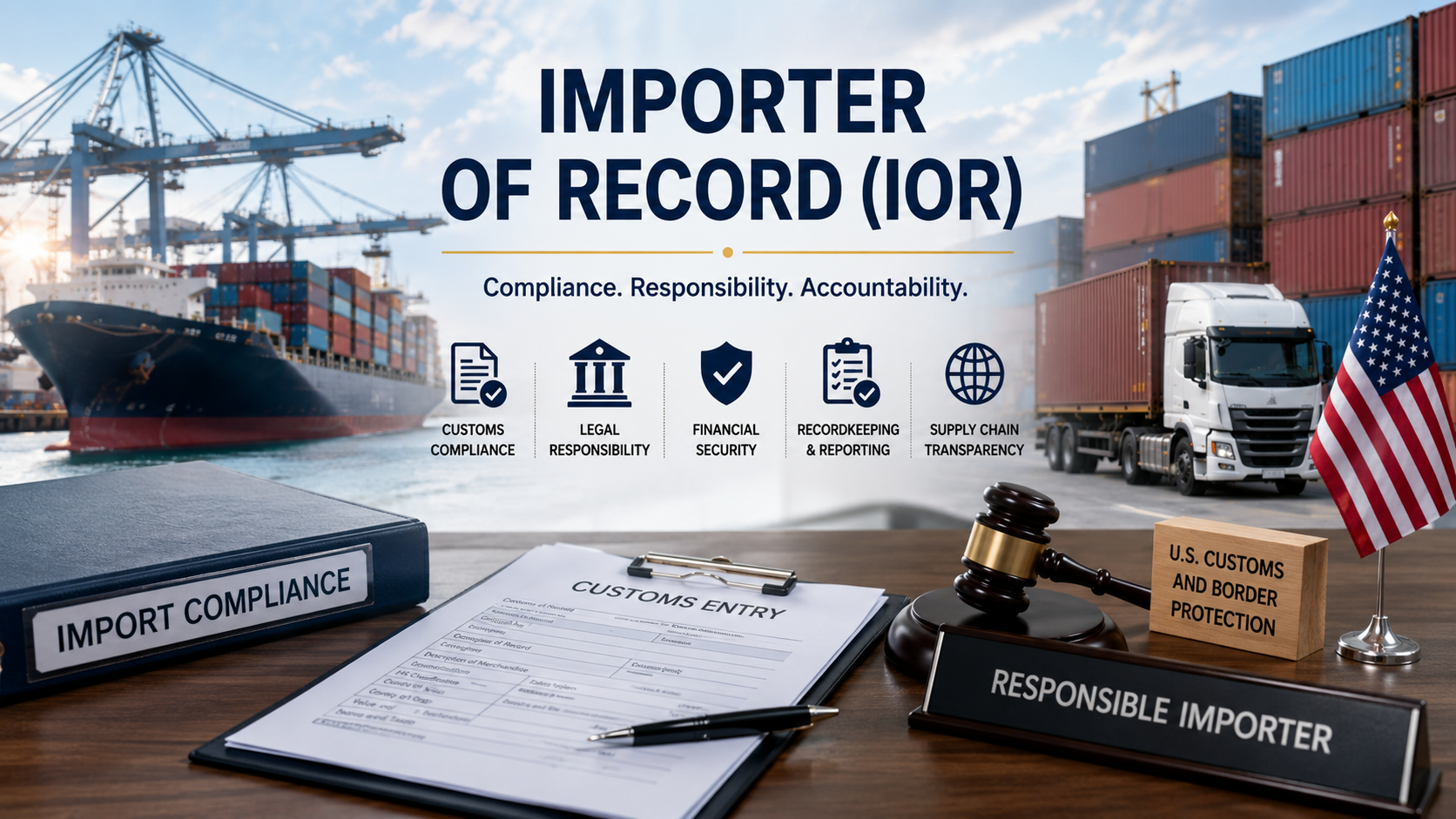
The Importer of Record is the party identified to U.S. Customs and Border Protection as responsible for the imported merchandise.
The IOR is generally responsible for using reasonable care when declaring the merchandise, including its classification, value, country of origin and eligibility for any special tariff treatment. The IOR is also responsible for paying duties, taxes and fees, maintaining required records, responding to CBP inquiries, and addressing compliance issues after the goods have been released.
A customs broker can prepare and transmit an entry on behalf of the importer, but the broker does not automatically replace the IOR's legal responsibilities.
This distinction is important. The customs broker files the entry, while the IOR remains the party whose identity and compliance history are connected to the transaction.
Why Have Hong Kong Companies Commonly Been Used as IORs?
Hong Kong companies have traditionally been attractive in international trade because they are familiar to Chinese exporters, can maintain international banking relationships, and are often used as regional sales or trading companies.
A typical structure may look like this:
- A manufacturer in mainland China sells goods to a Hong Kong trading company.
- The Hong Kong company sells the goods to U.S. customers or retains ownership while the goods move to a U.S. warehouse.
- The Hong Kong company is identified as the IOR.
- A U.S. customs broker submits the entry using the foreign company's CBP-assigned importer number.
- After clearance, the goods are delivered to a fulfillment center, warehouse, marketplace, distributor or final customer.
This model allows the foreign seller to control the transaction from the factory to the U.S. destination. It can also support DDP pricing because the seller or its logistics provider arranges transportation, customs clearance and duty payment before delivery.
For many businesses, this structure has been convenient. But convenience does not eliminate compliance responsibility.
If the declared value is incorrect, the classification is wrong, the country of origin is misstated, required product data is missing, or an antidumping or countervailing duty order applies, CBP may pursue the IOR for additional duties, liquidated damages, penalties or records.
The difficulty for the government is that a foreign IOR may have limited assets, personnel or operations in the United States. That can make enforcement and collection more difficult.
The New Direction for Foreign IOR Enforcement
The current policy direction focuses on distinguishing genuine U.S. importers from foreign entities or nominal U.S. companies that may lack meaningful operations and assets in the United States.
1. Restrictions on Informal Entries
One of the most significant policy directions is restricting foreign IORs from using informal entry procedures.
Informal entries have traditionally provided simplified processing for qualifying lower-value shipments. Restricting this option for foreign IORs could require more shipments to be processed as formal entries.
- More detailed entry documentation;
- Higher customs brokerage expenses;
- Additional bond requirements;
- More complete product and supply-chain data;
- Greater exposure to entry review;
- Longer processing times for certain shipments.
The impact may be particularly significant for cross-border e-commerce sellers and logistics programs handling many relatively low-value shipments.
2. Greater Scrutiny of Customs Bonds
A customs bond protects the U.S. government if the importer fails to pay duties, taxes, fees or other amounts owed.
Historically, some foreign IORs have used continuous bonds to cover multiple entries during a bond period. Under a stricter enforcement model, foreign IORs may face tighter standards for obtaining or maintaining continuous bonds.
A surety company may ask for financial statements, ownership information, import forecasts, duty projections, product descriptions, antidumping or countervailing duty exposure, collateral, evidence of U.S. assets and a stronger compliance history.
Some foreign importers may be required to use single-transaction bonds for individual shipments, particularly when the surety considers the importer or product high risk. This could substantially increase landed cost.
3. Beneficial-Ownership Disclosure
CBP is increasingly focused on knowing who controls the importing entity.
It may no longer be sufficient to provide only the company name, foreign address and importer number. Foreign importers should be prepared to identify direct and indirect owners, controlling individuals, affiliated companies, related manufacturers and sellers, U.S. subsidiaries or agents, estimated import volume, business activities, and locations where records are maintained.
These disclosures are intended to help CBP determine whether the IOR is a genuine operating business or merely a name being used to shield another party from responsibility.
4. U.S. Presence and U.S. Assets
Another major issue is whether the importer has a genuine presence in the United States.
A company should not assume that forming an LLC in Delaware, New York, New Jersey or another state automatically makes it a qualified U.S. IOR.
Regulators may look beyond the certificate of formation and ask whether the company has a real U.S. office, personnel, business records, a U.S. bank account, inventory, tangible assets and substantive commercial activity.
A registered agent or virtual mailbox alone may not demonstrate substantial U.S. operations.
This is particularly important for foreign sellers considering forming a U.S. company solely to replace a Hong Kong IOR. A newly formed U.S. LLC should not be treated as a simple compliance shortcut.
5. Importer Good Standing
IOR eligibility may increasingly depend on whether the importer remains in good standing.
Good standing may include accurate and timely entry filings, timely payment of duties and fees, valid importer identity information, a sufficient customs bond, cooperation with CBP inquiries, compliance with recordkeeping requirements, and compliance with partner-government-agency requirements.
An importer with repeated violations may face greater scrutiny, bond increases, importer-number problems, cargo delays or loss of access to certain entry procedures.
What Does This Mean for DDP Shipping?
DDP, or Delivered Duty Paid, is frequently offered as a simple all-inclusive logistics solution. Under a DDP arrangement, the seller is generally expected to arrange delivery and bear import-related costs up to the agreed destination.
In practice, however, the shipping term does not by itself answer an important customs question: Who is legally acting as the Importer of Record?
Some DDP channels have historically used a foreign trading company, a Hong Kong entity, a logistics company or a third-party importer to clear goods for multiple unrelated sellers.
Stricter foreign IOR rules could disrupt this model.
- DDP providers may require customers to provide their own U.S. IOR;
- They may refuse products with high regulatory risk;
- They may increase customs-clearance and compliance fees;
- They may require more detailed commercial invoices;
- They may request manufacturer and beneficial-ownership information;
- They may reject vague product descriptions;
- They may require deposits or collateral;
- They may separate transportation charges from IOR service fees.
The result may be that all-inclusive DDP pricing becomes less predictable and more expensive.
What Does This Mean for Cross-Border E-Commerce?
Cross-border sellers often focus on marketplace listings, advertising, fulfillment and customer delivery. Customs responsibility may receive attention only when a shipment is delayed.
Under stricter foreign IOR controls, that approach may no longer be sustainable.
A foreign seller shipping inventory to a U.S. fulfillment center should determine who owns the goods at importation, who has the right to make entry, which entity is the IOR, who holds the customs bond, who maintains the records, and who will respond to CBP inquiries or pay additional duties.
Marketplaces, warehouses and fulfillment centers do not automatically become the IOR merely because they receive the goods.
Cross-border sellers will need a clearly documented import structure before shipping.
Four Possible Operating Models
Model One: Continue Using a Foreign IOR
A genuine foreign operating company may still be able to act as IOR if it satisfies applicable requirements, provides required disclosures, maintains an acceptable bond and demonstrates compliance.
However, the company should expect stronger due diligence from customs brokers and sureties.
Model Two: Build a Genuine U.S. Importing Company
A foreign business may establish a U.S. subsidiary or affiliate to import and distribute its products.
The U.S. entity should have more than registration documents. It may need a real operating address, U.S. bank account, accounting and tax records, inventory ownership, commercial contracts, responsible personnel, adequate capitalization, insurance, a customs bond, a licensed customs broker, and written import-compliance procedures.
Model Three: Use the U.S. Buyer or Distributor as IOR
A U.S. distributor, wholesaler or customer may agree to purchase the goods under terms that make it responsible for importation.
This can simplify the foreign seller's U.S. customs exposure, but the agreement and Incoterms must clearly allocate responsibility. The U.S. buyer will likely demand pricing that reflects the duties, brokerage costs and compliance risk it assumes.
Model Four: Use a Qualified Third-Party IOR Service
A third-party IOR provider may be appropriate in some transactions, particularly when the foreign seller has no U.S. entity.
However, a legitimate IOR service cannot simply rent its name or importer number. The provider should review classification, customs valuation, country of origin, manufacturer information, product certifications, agency requirements, intellectual-property risk, forced-labor exposure, AD/CVD exposure and commercial documents.
Because the provider assumes real responsibility, legitimate IOR services may become more selective and expensive.
Customs Brokers Will Also Become More Cautious
As foreign IOR enforcement increases, brokers may request more extensive documentation before accepting a new importer.
A broker may request formation documents, identification, ownership charts, business licenses, websites, product catalogs, purchase orders, commercial invoices, financial information, bond documentation, U.S. warehouse information, expected import volume and explanations of related-party pricing.
A broker may refuse an account when it cannot verify the importer, understand the transaction or identify who actually controls the goods.
Therefore, selecting an IOR should occur before cargo is loaded—not after it arrives at a U.S. port.
What Should Importers Do Now?
- Confirm the legal identity of the current IOR.
- Verify that CBP importer information is accurate and current.
- Review the customs bond and renewal terms.
- Confirm who owns the merchandise at the time of entry.
- Review classifications, values and countries of origin.
- Identify all applicable partner-government-agency requirements.
- Determine where import records are stored.
- Review beneficial ownership and affiliated-party relationships.
- Evaluate whether the company has sufficient U.S. operations or assets.
- Develop a backup plan if the current IOR or bond becomes unavailable.
Importers should avoid waiting until a shipment is already at the port. Changing the IOR after arrival can create delays, storage charges, documentation conflicts and questions about the underlying transaction.
The Larger Impact on U.S. Imports
Stricter foreign IOR controls may change the economics of the entire supply chain.
- Higher landed costs;
- Increased demand for U.S.-based importers and distributors;
- Higher fees for legitimate IOR services;
- Reduced availability of informal-entry programs;
- Greater customs-bond collateral requirements;
- More detailed supply-chain disclosures;
- Longer onboarding by brokers and logistics providers;
- Less tolerance for unclear DDP arrangements;
- Greater separation between transportation services and legal import responsibility.
For compliant businesses, these changes may create additional work, but they may also reduce competition from sellers using inaccurate values, false descriptions, shell companies or structures designed to avoid accountability.
Conclusion
The central question is no longer simply whether a foreign company is technically capable of obtaining an importer number.
The more important questions are whether the importer is a genuine operating business, whether CBP can identify its owners and responsible parties, whether it has sufficient financial capacity, whether it understands the goods it imports, and whether it can meet its duty, recordkeeping and compliance obligations.
For businesses that have traditionally relied on a Hong Kong company as IOR, the safest approach is not to panic or immediately abandon the structure. The correct approach is to review the arrangement carefully, confirm the latest CBP requirements, and prepare an alternative U.S. import strategy.
In the new enforcement environment, the IOR is not merely a name entered into a customs system. It is the legal and financial foundation of the entire U.S. import transaction.
Disclaimer: This article is provided for general informational purposes only and does not constitute legal, tax or customs brokerage advice. Importers should consult a licensed customs broker, customs attorney or other qualified professional regarding their specific transactions.