
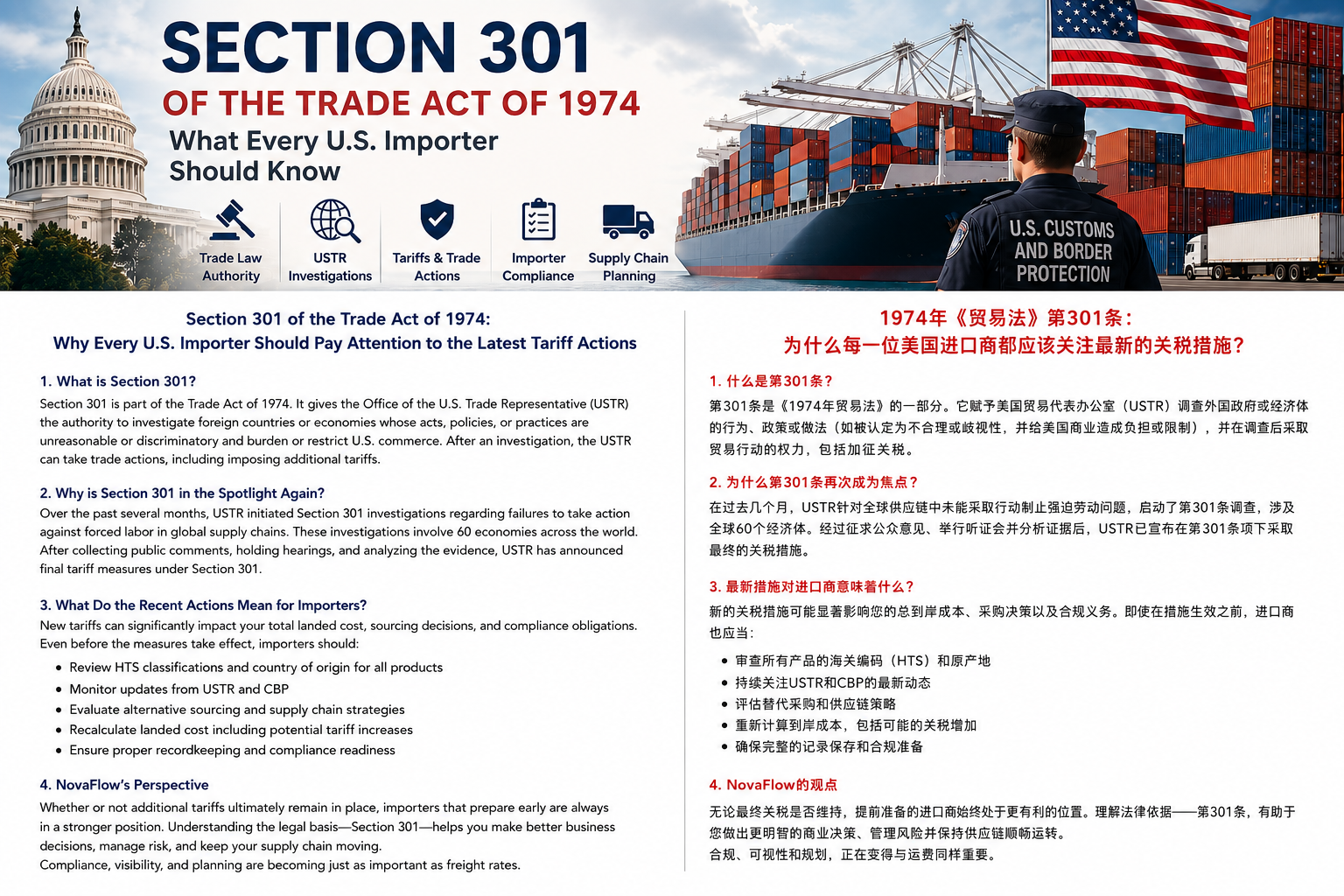
International trade is constantly changing. Tariff policies, customs enforcement, country-of-origin requirements, supply chain disruptions, and geopolitical developments can all affect the cost and reliability of importing goods into the United States.
One of the most important U.S. trade laws affecting importers is Section 301 of the Trade Act of 1974. Although the law was enacted more than fifty years ago, it remains a powerful trade enforcement mechanism and continues to influence sourcing decisions, customs compliance, supplier relationships, and total landed cost.
For U.S. importers, understanding Section 301 is not simply a legal exercise. It is an important part of purchasing, customs planning, pricing, inventory management, and long-term supply chain strategy.
1. What Is Section 301?
Section 301 gives the Office of the United States Trade Representative, commonly known as the USTR, authority to investigate certain foreign government acts, policies, or practices that may be considered unreasonable, discriminatory, or restrictive to United States commerce.
When the USTR determines that a foreign trade practice harms or burdens U.S. commerce, the United States may respond through trade actions. Depending on the investigation and the policy decision involved, those actions may include:
- Imposing additional tariffs on designated imported products
- Restricting certain trade benefits or concessions
- Negotiating changes with the foreign government involved
- Introducing other trade enforcement measures
Section 301 is different from an ordinary customs duty. A normal duty rate is generally determined by the product classification under the Harmonized Tariff Schedule of the United States, or HTSUS. A Section 301 duty is an additional trade remedy that may apply on top of the regular customs duty.
2. Why Does Section 301 Matter to Importers?
Additional duties can significantly change the economics of an import transaction. A product that appeared profitable when a purchase order was issued may become much more expensive by the time it arrives in the United States.
For example, an importer may calculate the purchase price, ocean freight, customs duty, brokerage fee, domestic transportation, and warehouse cost. If an additional tariff applies, the importer may face a much higher total landed cost than originally expected.
Section 301 measures may affect:
- Product pricing and profit margins
- Supplier and factory selection
- Country-of-origin planning
- Long-term purchasing agreements
- Inventory quantities and replenishment schedules
- Customer quotations and sales contracts
- Cash flow and duty-payment requirements
Importers should therefore evaluate tariff exposure before confirming a purchase order, not after the cargo has already departed.
3. HTS Classification Is the Starting Point
Whether a product is subject to an additional tariff usually depends heavily on its HTSUS classification. An incorrect classification can result in underpayment or overpayment of duties, shipment delays, penalties, and inaccurate landed-cost calculations.
Importers should review the product carefully and maintain supporting information such as:
- Product specifications
- Material composition
- Principal function and intended use
- Technical drawings
- Catalogs and photographs
- Supplier descriptions
- Previous customs rulings, when applicable
A supplier-provided tariff code may be useful as a reference, but the U.S. importer remains responsible for using the correct classification when goods are entered into the United States.
4. Country of Origin Must Be Determined Correctly
Section 301 applicability may also depend on the product's country of origin. Country of origin is not always determined by the country from which the shipment was exported or the location shown on the commercial invoice.
Goods may pass through a third country, be stored in a foreign warehouse, or receive minor processing in another location. Those activities do not automatically change the legal country of origin.
Importers should determine whether manufacturing or processing in another country results in a substantial transformation. Simply repacking, relabeling, sorting, or conducting minor assembly may not be sufficient to establish a new country of origin.
Incorrect origin declarations can create serious risks, particularly when additional tariffs or trade remedies are involved.
5. Section 301 Duties May Be Additional to Other Charges
Importers should understand that Section 301 duties may apply in addition to other import-related charges. Depending on the product and transaction, the total amount payable may include:
- Regular customs duty
- Section 301 additional duty
- Antidumping or countervailing duties, when applicable
- Merchandise Processing Fee
- Harbor Maintenance Fee for applicable ocean entries
- Brokerage, examination, storage, and transportation charges
This is why the lowest factory price does not always produce the lowest landed cost. Importers must evaluate the complete transaction rather than focusing only on the supplier's unit price or the international freight rate.
6. Do Not Assume That Last Month's Entry Determines Today's Treatment
Importers sometimes assume that a product will receive the same customs treatment because a previous shipment was released without difficulty. That assumption can be risky.
Tariff lists, exclusions, customs interpretations, product descriptions, and enforcement priorities may change. A previous entry may also have contained a classification or origin error that was not identified at the time of release.
Each shipment should be reviewed based on the applicable requirements in effect at the time of entry. Importers should confirm the current tariff treatment before relying on historical entry data.
7. What Should Importers Do?
Importers do not need to wait for a shipment problem before reviewing their exposure. A proactive compliance process should include the following steps:
Review HTS Classifications
Confirm that classifications are supported by accurate product information and are consistently used across purchase orders, commercial invoices, customs entries, and internal product databases.
Verify Country of Origin
Understand where the product is actually manufactured and what operations occur in each country. Keep production records and supplier statements that support the origin determination.
Monitor Trade Developments
Trade measures can change. Importers should monitor official announcements and coordinate with qualified customs professionals before making decisions based on a possible tariff change, exclusion, or effective date.
Recalculate Total Landed Cost
Cost analysis should include regular duty, possible additional tariffs, transportation, customs fees, insurance, examination expenses, warehousing, and domestic delivery.
Evaluate Alternative Sourcing
Supplier diversification can reduce dependence on a single country or factory. However, moving production requires careful review of quality, capacity, lead time, intellectual property protection, origin rules, and overall cost.
Maintain Complete Records
Importers should retain documentation supporting classification, valuation, origin, admissibility, and duty calculations. Good recordkeeping is essential if CBP later questions an entry.
8. Avoid Artificial Transshipment
Importers should never attempt to avoid additional tariffs by routing merchandise through another country and declaring that country as the origin when no legally sufficient manufacturing transformation occurred.
Changing an invoice, replacing labels, repacking goods, or shipping through a third country does not automatically change origin. Such practices may be treated as false statements, duty evasion, or customs fraud.
Legitimate supply chain restructuring is possible, but it must be based on genuine manufacturing operations and a properly supported origin analysis.
9. Compliance and Supply Chain Planning Must Work Together
Section 301 demonstrates why customs compliance can no longer be separated from purchasing and logistics. The purchasing team may negotiate the product price, the logistics team may arrange transportation, and the customs broker may transmit the entry. However, the importer remains responsible for the overall accuracy of the import transaction.
Before placing an order, companies should ask:
- What is the correct HTSUS classification?
- What is the legally supportable country of origin?
- Are additional duties or trade remedies applicable?
- What documentation will be required at entry?
- How will a tariff increase affect the selling price?
- Is there a qualified alternative supplier?
- How much inventory should be ordered before a policy change?
These questions should be answered before the shipment leaves the factory whenever possible.
10. NovaFlow USA's Perspective
At NovaFlow USA, we believe that modern importing is no longer only about comparing ocean freight, airfreight, or trucking rates. Successful importing requires an understanding of customs compliance, tariff exposure, cargo visibility, documentation, supply chain risk, and total landed cost.
Section 301 is a clear example of how trade policy can directly affect day-to-day business operations. A tariff decision made at the government level may change the cost of a purchase order, the profitability of a product line, or the location of a future factory.
Importers that review classifications, verify origin, maintain complete records, and prepare alternative sourcing strategies are generally in a stronger position to respond to trade-policy changes.
Compliance, visibility, and planning are becoming just as important as freight rates. The goal is not simply to move a shipment from one location to another. The goal is to build a stable, transparent, and legally compliant supply chain.