
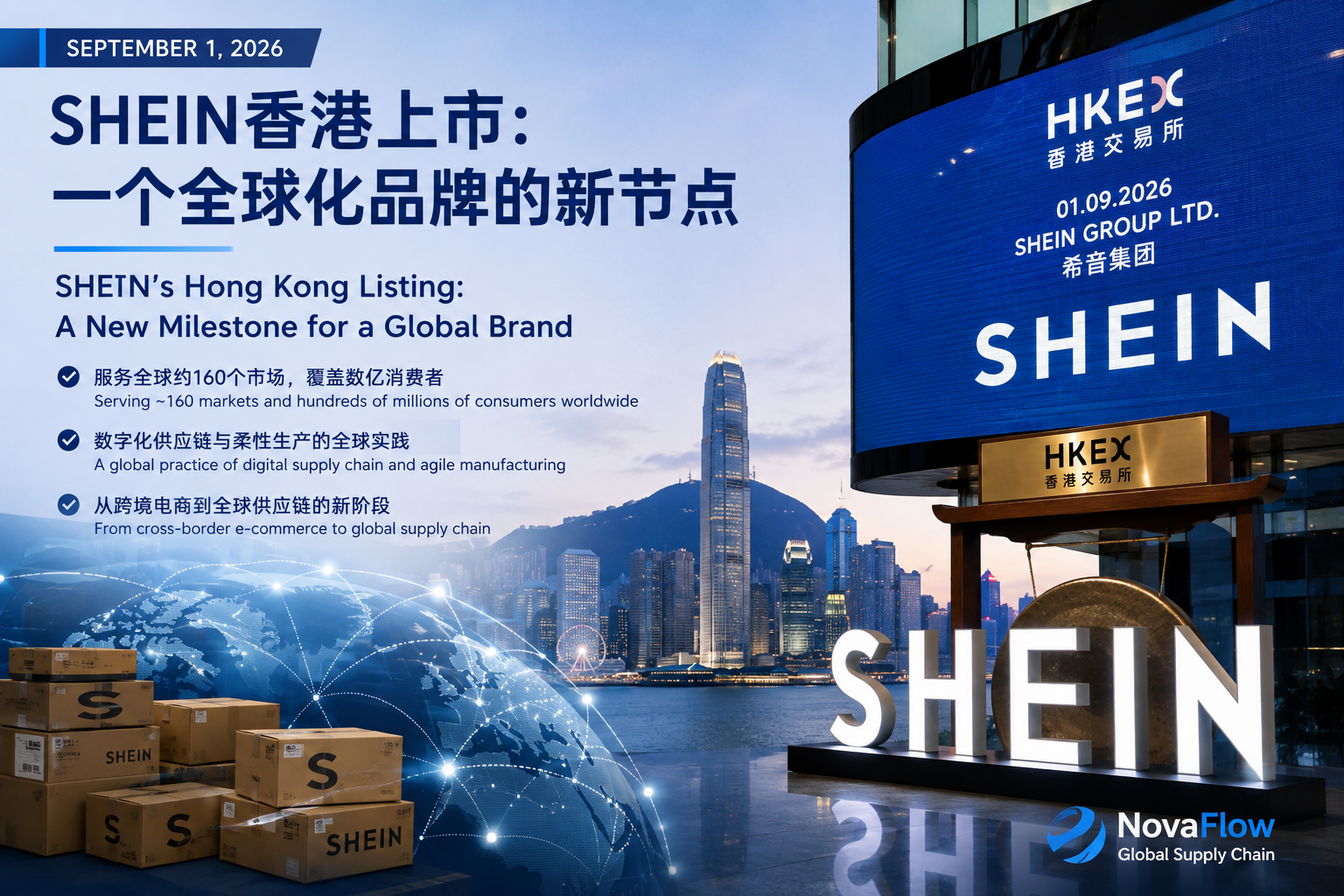
On September 1, 2026, SHEIN began trading in Hong Kong, marking another important milestone in the development of one of the world's most recognizable global e-commerce businesses.
For those of us working in cross-border e-commerce, logistics and supply chain, the significance of this moment goes beyond the performance of a stock on its first trading day.
SHEIN is not a company that is just beginning to become global. It is already a global business, serving consumers across markets around the world.
Its Hong Kong listing therefore gives us an opportunity to look at a much broader story: how cross-border e-commerce has evolved over the past decade, and what that evolution means for the global supply chain.
From Cross-Border Selling to Global Operations
In the early years of cross-border e-commerce, the business model was relatively straightforward.
China had enormous manufacturing capacity and a highly competitive supplier base. Digital platforms made it possible for overseas consumers to discover products made in China, while international parcel networks connected Chinese sellers directly with customers in the United States, Europe and other markets.
At that time, many of the most important questions were simple: How do we reach overseas customers? How quickly can we ship an order? How much does international delivery cost?
Today, global e-commerce has become far more sophisticated.
SHEIN is a strong example of that transformation. Its business connects consumer demand, digital technology, product development, flexible manufacturing, supplier management, inventory and global fulfillment.
That is very different from simply shipping products from one country to another.
It is the operation of a global supply chain.
The Market Has Become More Complex
The international trade environment is also changing.
Tariffs, customs regulations, low-value shipment policies, product compliance requirements and supply-chain transparency are becoming increasingly important in major markets.
At the same time, consumers still expect competitive prices, fast delivery and convenient returns.
For companies selling globally, this creates a much more complicated supply-chain equation.
The question is no longer simply:
How much does it cost to ship this product from China to the United States?
Companies must now consider the complete landed cost, including international transportation, duties, customs clearance, warehousing, inventory, fulfillment, last-mile delivery and returns.
Logistics Is Becoming Part of the Business Strategy
This change is especially important for logistics providers.
Traditionally, logistics was often viewed primarily as transportation: moving goods from Point A to Point B.
Today, global e-commerce companies increasingly need integrated solutions.
Should products be shipped directly from Asia or imported in bulk? Where should inventory be positioned? Which port or airport should be used? Which warehouse is closest to the customer base? Should final-mile delivery use a national carrier or regional networks? How should returns be managed?
These are no longer simply transportation questions.
They are supply-chain decisions.
As cross-border e-commerce becomes more mature, logistics providers will increasingly compete not only on transportation rates, but also on their ability to connect international transportation, customs clearance, warehousing, fulfillment and final-mile delivery.
A Milestone, Not a Beginning
SHEIN's Hong Kong listing should not be viewed as the beginning of its globalization.
The company is already global.
Instead, the listing represents another milestone in the development of a business that grew from deep connections with China's manufacturing and digital ecosystem and built operations serving consumers around the world.
Its journey also reflects a broader transformation taking place across the cross-border industry.
Cross-border e-commerce is no longer only about selling products overseas.
It is increasingly about connecting manufacturing, technology, inventory, logistics and consumers across multiple countries into one global supply-chain system.
SHEIN's listing gives the industry a good moment to recognize how far that transformation has already come.
And for those of us working in global logistics and supply chain, it also raises an important question:
How do we build the infrastructure and services needed for the next stage of global commerce?