
Importers often use the words rejection, hold, examination, and release delay as though they mean the same thing. In practice, they may describe different stages of the U.S. Customs and Border Protection clearance process.
An electronic entry may be rejected because the information transmitted through the Automated Commercial Environment, commonly known as ACE, does not satisfy system or regulatory requirements. An entry may also be accepted by the system but remain unreleased because CBP or a Partner Government Agency requires additional review.
These problems can delay cargo release and may create storage charges, demurrage, examination costs, document correction fees, missed delivery appointments, and supply-chain disruption. Importers should therefore understand not only why an entry may be rejected, but also how to identify the actual problem and respond appropriately.
Entry Rejection, Cargo Hold, and Examination Are Not the Same
Before discussing the most common causes, it is important to distinguish among several different customs situations.
Entry Rejection
An entry rejection generally means that the transmitted entry data was not accepted as filed. The filer may need to correct one or more data elements and retransmit the entry.
The rejection may involve an invalid importer number, missing required data, an incorrect entry type, a bond problem, an invalid tariff number, or an incomplete Partner Government Agency message set.
CBP Hold
A hold usually means that the entry has been received but the shipment cannot yet be released. CBP may need additional documentation, clarification, or internal review before making a release decision.
Partner Government Agency Hold
A shipment may also be held by an agency such as the Consumer Product Safety Commission, Food and Drug Administration, Environmental Protection Agency, Department of Agriculture, or Federal Communications Commission.
In this situation, CBP may be unable to release the cargo until the responsible agency completes its review.
Customs Examination
An examination means that CBP or another agency has selected the shipment for additional review. The examination may involve an X-ray, document review, package inspection, or intensive physical examination.
A shipment may have accurate entry information and still be selected for an examination. Therefore, an examination does not automatically mean that the importer or customs broker made an error.
1. Incorrect or Incomplete Entry Information
One of the most common causes of an entry rejection or clearance delay is inaccurate, inconsistent, or incomplete shipment information.
Examples may include:
- An invalid or incomplete HTS classification;
- An incorrect country of origin;
- A vague or misleading product description;
- An incorrect quantity, weight, or entered value;
- A missing manufacturer identification code;
- An incorrect port code or mode of transportation;
- An incorrect entry type;
- Missing consignee or ultimate consignee information; and
- Information that does not match the commercial invoice or transportation documents.
Product descriptions such as “parts,” “samples,” “accessories,” or “general merchandise” may be insufficient because they do not clearly identify what the merchandise is, what it is made of, or how it will be used.
The customs broker normally prepares the entry using information supplied by the importer, seller, manufacturer, freight forwarder, or overseas agent. If the original documents are incomplete, the broker may not have enough information to prepare an accurate entry.
How Importers Can Reduce the Risk
- Provide the broker with complete commercial invoices before arrival;
- Use detailed product descriptions rather than general descriptions;
- Confirm the correct HTS classification before shipping;
- Verify the country of origin for each product;
- Make sure quantities, values, weights, and part numbers match across all documents;
- Identify any assists, royalties, commissions, or related-party transactions; and
- Notify the broker of unusual transactions before the entry is filed.
2. Importer of Record Identification Problems
The Importer of Record, commonly referred to as the IOR, is the party responsible for the customs entry and for exercising reasonable care regarding the classification, valuation, origin, admissibility, and payment of duties, taxes, and fees.
An importer number is generally based on an Employer Identification Number, Social Security Number, or a CBP-assigned importer number. The number must be properly established and associated with the correct legal entity.
Importer-related problems may arise when:
- The importer number is invalid or inactive;
- The company name does not match CBP records;
- The business address has changed but the importer record was not updated;
- The importer is using the EIN of another company;
- A foreign importer has not properly established a CBP-assigned number;
- The customs broker does not have a valid Power of Attorney;
- The signer of the Power of Attorney is not authorized to bind the company; or
- The importer cannot be verified as the party responsible for the transaction.
These problems commonly occur when companies change names, reorganize, merge, use a new address, establish a new subsidiary, or begin importing under a different legal entity.
How Importers Can Reduce the Risk
- Confirm the exact legal company name shown in IRS and state records;
- Make sure the EIN belongs to the company acting as Importer of Record;
- Update CBP Form 5106 information when company information changes;
- Use an authorized corporate officer to sign the Power of Attorney;
- Do not use another company as IOR without understanding the legal consequences; and
- Complete importer verification before the cargo departs from origin.
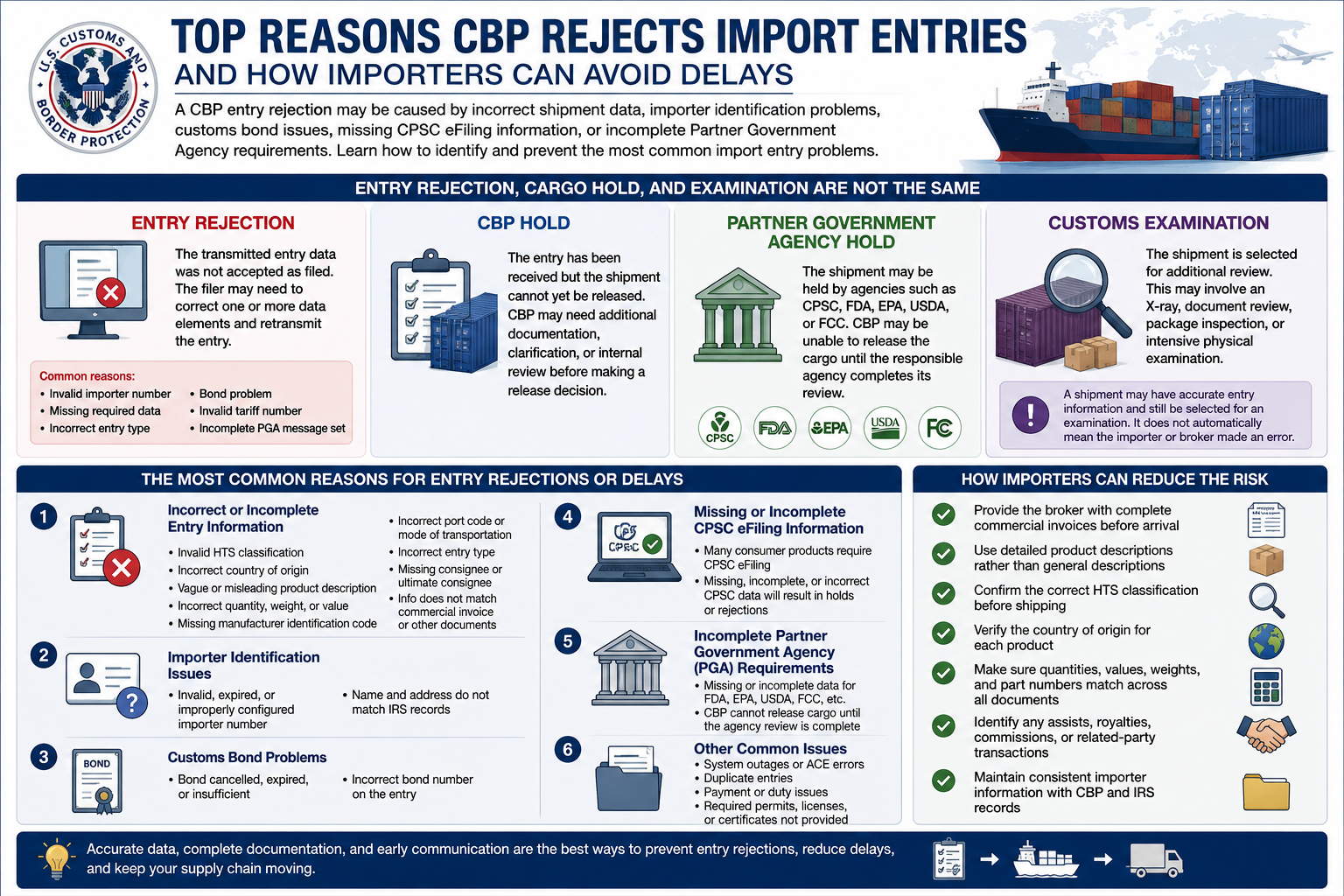
Common causes of CBP entry rejections include inaccurate shipment data, CPSC eFiling issues, Importer of Record problems, customs bond problems, and incomplete Partner Government Agency requirements.
3. Customs Bond Problems
Customs bonds are an important part of the import process. A bond protects the U.S. government by securing the importer's obligations, including payment of duties, taxes, fees, and certain penalties or liquidated damages.
Formal entries generally require a customs bond. Some goods regulated by other federal agencies may also require a bond even when the shipment value would otherwise qualify for an informal entry.
Common bond-related problems include:
- No bond is on file for the Importer of Record;
- The continuous bond has terminated or become inactive;
- The bond was issued under an incorrect importer number;
- The importer changed legal entities but continued using the old bond;
- The bond amount is insufficient for the importer's current activity;
- The surety has taken action affecting the bond; or
- A required single-transaction bond has not been obtained.
Continuous bond sufficiency is commonly associated with the importer's duties, taxes, and fees over a twelve-month period. Increased import volume, higher tariff rates, antidumping or countervailing duty exposure, or changes in the importer's product mix may cause an existing bond to become inadequate.
When a bond problem exists, filing another entry under the same importer number may not resolve the problem. The importer may need to work with the customs broker and surety to obtain a replacement bond, increase the bond amount, correct the importer information, or obtain a single-transaction bond.
How Importers Can Reduce the Risk
- Monitor import volume and annual duty exposure;
- Review bond sufficiency before a major increase in imports;
- Respond promptly to notices from CBP, the customs broker, or the surety;
- Confirm that the bond is issued under the correct importer number;
- Plan in advance for goods subject to antidumping or countervailing duties; and
- Do not wait until cargo arrives to address an inactive or insufficient bond.
4. CPSC eFiling and Certificate Problems
Beginning July 8, 2026, importers of most regulated consumer products that require certification must electronically file certificate information with CBP through a CPSC Partner Government Agency Message Set.
The underlying certificate may be a Children's Product Certificate, commonly called a CPC, or a General Certificate of Conformity, commonly called a GCC, depending on the type of product and the applicable consumer product safety requirements.
Common CPSC-related problems may include:
- A regulated product is filed without the required certificate data;
- The filer submits a disclaim code when a certificate is actually required;
- The citation or testing exclusion code is incorrect;
- The manufacturer or importer information does not match the certificate;
- The product identifier does not match the imported merchandise;
- The certificate contains incomplete testing laboratory information;
- The certificate references the wrong safety rule or regulation;
- The certificate was created for a different model or product variation; or
- The Full Message Set or Reference Message Set contains invalid data.
Importers should not assume that the customs broker is responsible for creating the product certificate. The importer or domestic manufacturer is generally responsible for ensuring that the product has been properly tested and that a valid certificate exists.
The broker may electronically transmit the certificate data, but the accuracy and legal sufficiency of the underlying certificate remain critical.
How Importers Can Reduce the Risk
- Determine whether each product is subject to a CPSC rule before shipment;
- Identify whether a CPC, GCC, or valid disclaim applies;
- Review certificates against the actual model, style, and product identifier;
- Provide certificate data to the broker before the entry is transmitted;
- Confirm manufacturer, laboratory, testing date, and citation information;
- Maintain supporting test reports and compliance records; and
- Test the electronic filing process before high-volume shipments arrive.
5. Other Partner Government Agency Requirements Are Incomplete
CBP enforces import requirements on behalf of many Partner Government Agencies. Therefore, acceptance of the basic customs entry does not necessarily mean that the merchandise is admissible.
Depending on the product, another agency may require:
- Electronic message-set data;
- Product registration information;
- Facility registration information;
- Prior notice;
- Permits or licenses;
- Testing or certification records;
- Ingredient or chemical information;
- Manufacturer and production information;
- Labeling declarations; or
- Additional supporting documents.
For example, food, cosmetics, medical devices, and certain radiation-emitting products may involve FDA requirements. Pesticides, chemicals, and certain engines may involve EPA requirements. Agricultural goods, plants, wood packaging, and animal products may involve USDA requirements.
Consumer products may involve CPSC, while electronic devices may involve FCC requirements. Some products may be regulated by more than one agency at the same time.
How Importers Can Reduce the Risk
- Identify all applicable government agencies before purchasing the goods;
- Do not rely only on the HTS code to determine regulatory requirements;
- Provide permits, registrations, and supporting documents before arrival;
- Confirm whether the manufacturer and foreign facility are properly registered;
- Review packaging and labeling requirements before production is completed; and
- Consult qualified specialists when importing a new or highly regulated product.
6. Commercial Invoice and Valuation Problems
Even when the merchandise is admissible, CBP may question or reject information when the commercial invoice does not provide enough detail to support the entry.
Common valuation and invoice concerns include:
- Invoices marked “no commercial value” without a supportable value;
- Samples, gifts, or replacement goods declared at an unrealistically low value;
- Freight, assists, commissions, or royalties handled incorrectly;
- Related-party transactions that are not properly disclosed;
- Discounts that are not adequately documented;
- Multiple currencies used without clear identification;
- Unit prices that do not match the total invoice value; and
- Different values shown on the invoice, packing list, manifest, or purchase order.
Free merchandise does not automatically have zero customs value. Samples, replacements, returns, intercompany transfers, and promotional goods still require a legally supportable value for customs purposes.
7. Manifest, Bill of Lading, or Arrival Information Does Not Match
Entry data must be associated with the correct transportation record. A mismatch involving the master bill, house bill, airway bill, container number, quantity, weight, or arrival port may prevent the entry from matching the manifest.
Common examples include:
- The house airway bill was transmitted incorrectly;
- The entry uses the wrong master or house bill number;
- The manifest quantity differs from the entry quantity;
- The shipment arrived at a different port than expected;
- The carrier amended the manifest after the entry was prepared;
- The cargo was split between flights or containers; or
- The entry was filed before the final transportation data was available.
The importer, freight forwarder, carrier, and customs broker may each control different parts of the shipment information. Timely communication is therefore necessary when transportation details change.
What Should an Importer Do After Receiving a Reject?
A rejection should not be handled by repeatedly retransmitting the same information without understanding the cause. The first step is to obtain the exact rejection message, error code, or agency response from the filer.
- Identify the source of the message. Determine whether it came from CBP, CPSC, FDA, another government agency, the carrier, or the customs broker's internal system.
- Determine whether it is a rejection or a hold. A technical transmission rejection may require a data correction, while a hold may require documents or agency review.
- Compare the entry with the source documents. Review the invoice, packing list, bill of lading, certificate, bond, and importer information.
- Correct the underlying information. Do not change data merely to make the system accept the filing if the revised information would be inaccurate.
- Resubmit or respond through the proper channel. The customs broker may retransmit the entry, submit supporting documents, contact the agency, or follow instructions issued by CBP.
- Document the resolution. Maintain the rejection message, corrected documents, communications, and final release information in the import record.
Best Practices Before Cargo Departs
Many entry problems can be prevented before cargo leaves the foreign country. Importers should establish a pre-shipment compliance review that includes:
- Confirming the Importer of Record and Power of Attorney;
- Checking that the customs bond is active and sufficient;
- Reviewing HTS classification, value, and country of origin;
- Identifying all applicable Partner Government Agencies;
- Collecting CPSC, FDA, EPA, USDA, or FCC information as applicable;
- Reviewing the commercial invoice and packing list;
- Verifying the manufacturer, seller, and consignee information;
- Confirming the correct entry type;
- Providing documents to the customs broker before arrival; and
- Resolving unusual transactions before the filing deadline.
Conclusion
A CBP entry rejection is not always caused by a single customs filing mistake. It may result from inaccurate commercial documents, an invalid importer number, an inactive customs bond, incomplete CPSC certificate data, missing PGA requirements, or a mismatch between entry and transportation records.
Importers should also recognize the difference between an electronic rejection, an agency hold, and a customs examination. Each situation requires a different response.
The most effective strategy is preparation before shipment. Accurate product information, complete certificates, valid importer records, sufficient bonds, and early communication with the customs broker can significantly reduce clearance delays and unexpected costs.