
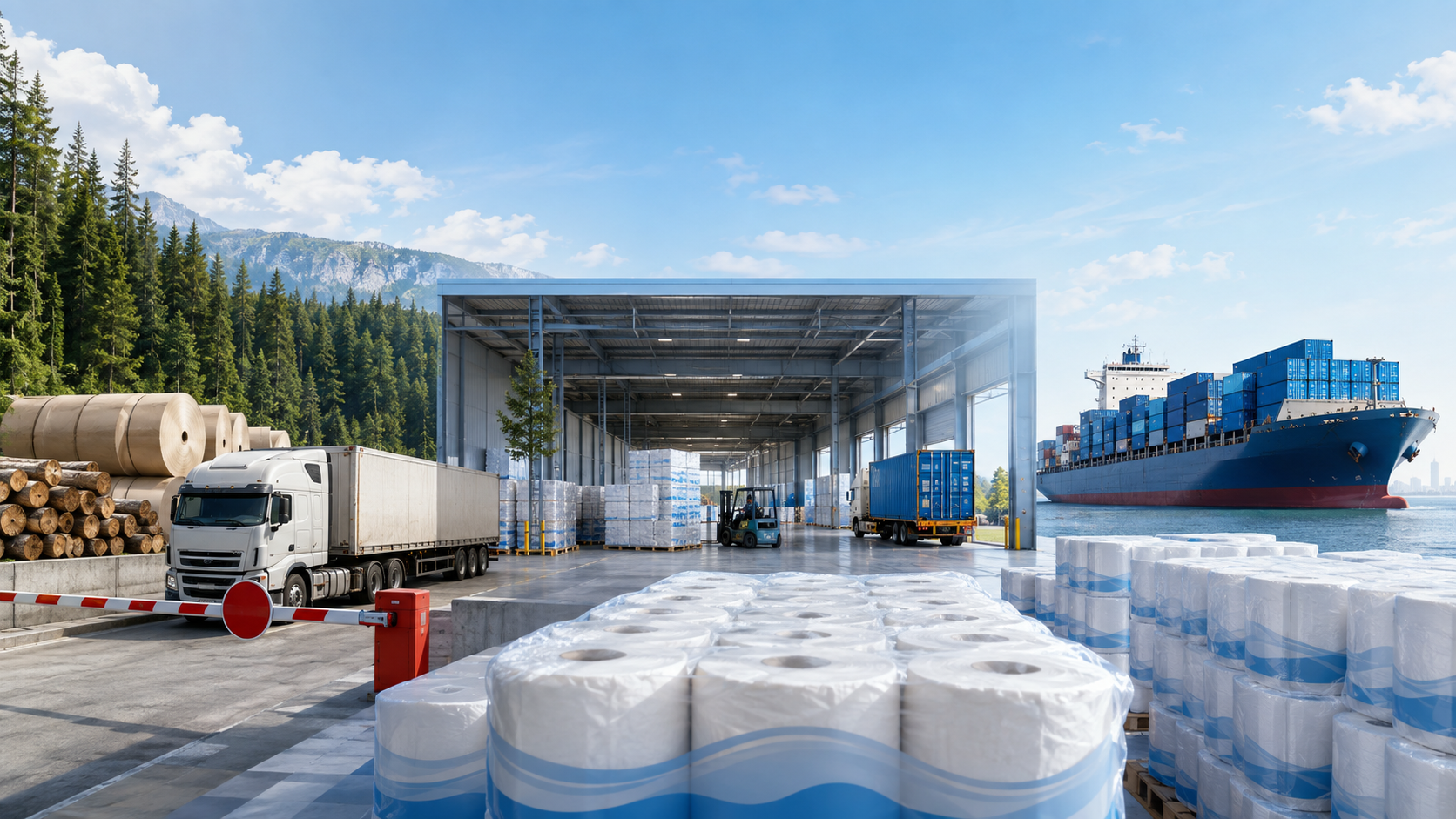
Toilet paper rarely sounds like a strategic international trade product. Yet when one of the world’s largest tissue-consuming markets becomes involved in a tariff dispute with its most important neighboring supplier, an everyday bathroom product becomes a serious question of sourcing, transportation and landed cost.
The latest U.S.–Canada trade measures have placed paper products directly in the dispute. The United States imposed an additional 50% tariff on selected Canadian goods, including certain toilet or facial tissue stock under HTS 4803.00.40. Canada announced counter-tariffs effective September 8, 2026, including 50% on certain U.S.-origin tissue stock and 25% on U.S.-origin finished toilet paper.
These measures do not mean that North America is about to run out of toilet paper. They do mean that a highly integrated paper supply chain may become more expensive—and that buyers may begin comparing alternative suppliers.
Why Toilet Paper Matters More Than It Sounds
The United States has an unusually large market for tissue products. Industry estimates cited in recent reporting indicate that the country accounts for more than 20% of global tissue consumption despite representing only about 4% of the world’s population. Americans are also estimated to use approximately 141 rolls of toilet paper per person each year.
The United States produces a substantial amount of finished tissue domestically, but domestic manufacturing does not make the supply chain fully domestic. Canadian forests, pulp mills, tissue stock and finished products have long supported the U.S. market. Recent reporting, based on international trade data, estimated that the United States imported approximately $328 million of toilet paper from Canada in 2024.
This distinction is important: a roll may be converted, packaged or branded in the United States while still depending on Canadian raw material or parent rolls. A tariff applied upstream can eventually appear downstream in production costs, wholesale prices or retail prices.
Is This a New Opportunity for China?
Potentially—but it is not a new market for China and it is not an automatic windfall.
Chinese manufacturers already supply toilet paper and other tissue products to the United States. World Bank WITS data, based on UN Comtrade, reports approximately $96.5 million of Chinese exports of HS 481810 toilet paper to the United States in 2024. Existing trade means that factories, importers, distributors and sales channels are already in place.
If the landed cost of Canadian products rises, American buyers may request new quotations from suppliers in China, Mexico, Indonesia, Vietnam and other markets. Chinese factories may receive additional attention in product categories such as:
- private-label retail tissue;
- commercial and institutional jumbo rolls;
- facial tissue and paper towels;
- compact or high-density packaging designed to improve container utilization;
- customized pack sizes for wholesalers, hotels, restaurants and e-commerce sellers.
The opportunity is therefore not that China suddenly discovered the American tissue market. The opportunity is that tariff pressure may create a new sourcing window in a market where Chinese manufacturers already participate.
Why a Low Factory Price Is Not Enough
Toilet paper has an unusual logistics problem: it occupies a great deal of space relative to its value. An attractive factory price can disappear after ocean freight, duties, port charges, drayage, warehousing and domestic delivery are added.
An importer comparing Canada and China must examine the entire landed-cost equation:
- the correct HTS classification and all applicable U.S. duties;
- country-of-origin rules and any China-specific additional tariffs;
- units per container and the amount of air in the packaging;
- ocean freight, port fees and inland transportation;
- U.S. warehousing and fulfillment costs;
- product quality, softness, ply count, roll size and packaging standards;
- delivery speed, inventory requirements and returns.
Canada still has important structural advantages: abundant fiber resources, established North American production and short transportation distances. China has manufacturing scale, flexible packaging, private-label experience and competitive conversion capacity. The winner will not necessarily be the supplier with the lowest factory price. It will be the supplier that can deliver the required product to the buyer’s warehouse at the lowest reliable total cost.
Opportunity Does Not Mean Panic Buying
Toilet paper naturally produces memorable headlines because consumers remember the empty shelves of the pandemic. However, tariff risk should not be confused with proof of a new nationwide shortage or widespread stockpiling.
The more responsible business question is not whether consumers will panic. It is whether importers, retailers and distributors will diversify their suppliers before higher costs reach the shelf.
That change can occur quietly. A retailer may test a private-label product. A distributor may ask for a second origin. A hotel supplier may compare commercial rolls from several countries. A manufacturer may redesign packaging to fit more units into a container. Each decision is small, but together they can redirect trade.
The Larger Lesson for Chinese Manufacturers
The U.S.–Canada trade dispute does not directly remove the duties applicable to Chinese goods. Chinese products must still comply with U.S. tariff, origin, labeling, safety and import requirements. Nevertheless, when a major competing source becomes more expensive, relative competitiveness can change even if China’s own tariff rate remains the same.
For Chinese manufacturers, the correct response is not to assume that every tariff creates an easy export opportunity. It is to prepare a credible U.S. landed-cost proposal, improve container efficiency, confirm classification and origin, and build dependable warehousing and distribution support.
Conclusion
The toilet paper story may sound humorous, but the supply-chain lesson is serious. The United States is a very large tissue market, Canada is a critical supplier, and new tariffs may encourage buyers to reconsider sourcing.
China already has manufacturers and products in this market. The latest trade friction may create an opening to expand that presence, especially in private-label, commercial and efficiently packaged tissue products. But the opening becomes a real business opportunity only when the final landed cost—including duties, freight, warehousing and delivery—can compete.
Tariffs do not automatically create winners. They create a moment when buyers recalculate—and prepared suppliers get another chance to quote.