
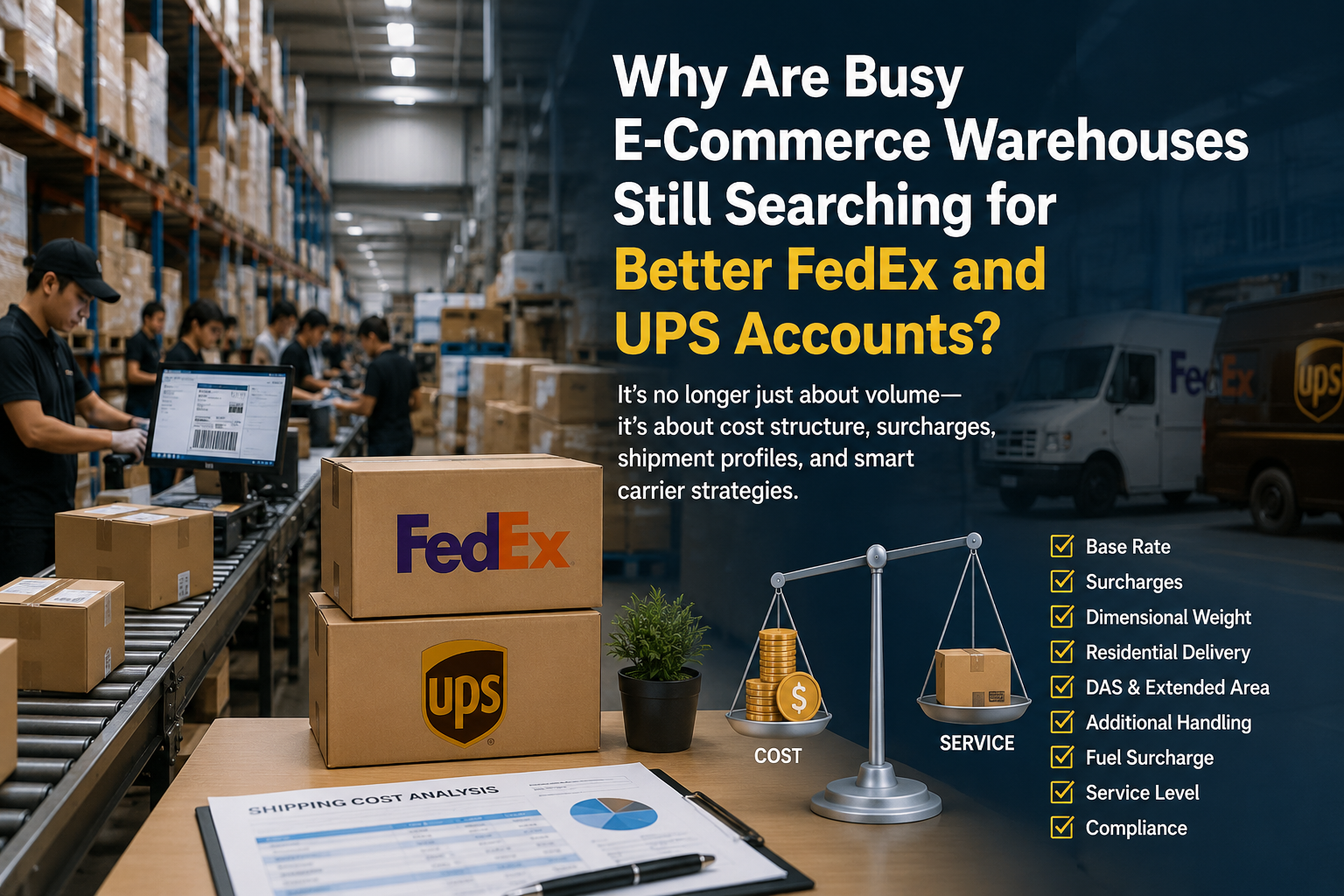
Parcel volume alone does not guarantee competitive shipping costs. In today's e-commerce logistics market, the right carrier account can be just as important as the warehouse itself.
A Busy Warehouse Can Still Have a Transportation Cost Problem
Walk into a busy e-commerce fulfillment warehouse today and you may see thousands of packages moving through receiving, sorting, labeling, packing, and outbound operations.
The warehouse is busy. The customers are there. The volume is there.
Yet one question continues to come up:
“Do you have a better FedEx or UPS account?”
At first, this may seem surprising.
If a warehouse already has significant shipping volume, shouldn't it automatically receive competitive rates from major parcel carriers?
Not necessarily.
Shipping Volume Is Only the Beginning
For many years, parcel shipping negotiations were heavily driven by volume. The logic was simple:
More packages = better rates.
Volume still matters, but today's parcel cost structure is much more complicated.
The actual cost of shipping a package may depend on many factors, including:
- Base transportation rate
- Shipping zone
- Package weight
- Dimensional weight
- Residential delivery surcharge
- Delivery Area Surcharge (DAS)
- Extended-area charges
- Fuel surcharge
- Additional handling
- Oversize charges
- Pickup charges
- Peak or demand surcharges
- Service level
- Label and shipment compliance
Two warehouses shipping the same number of packages can therefore have very different transportation costs.
The difference may not be the warehouse operation at all.
It may be the carrier agreement behind the shipping label.
The Shipping Label Has Become Part of the Business Model
In e-commerce fulfillment, the shipping label is no longer simply the last step before a package leaves the warehouse.
It has become part of the economics of the entire operation.
Imagine two fulfillment companies processing the same product. Both receive the inventory, pick and pack the order, print a shipping label, and hand the package to a carrier.
Operationally, they may look almost identical.
But if one company has a significantly better parcel agreement, its total fulfillment cost can be lower on every shipment.
Multiply a small difference by 10,000, 50,000, or 100,000 packages, and the impact becomes substantial.
That is why warehouses continue searching for better carrier programs even when they already have FedEx or UPS accounts.
They are not necessarily looking for another carrier.
They are looking for a better cost structure.
Surcharges Are Becoming More Important
One of the biggest mistakes in parcel logistics is focusing only on the quoted base rate.
The base rate is only part of the final transportation cost.
Major parcel carriers continue to adjust surcharges, service areas, handling rules, demand charges, and other pricing components.
A package may appear inexpensive based on its transportation rate but become significantly more expensive after residential, delivery-area, fuel, dimensional-weight, or handling charges are added.
This is especially important for high-volume shippers.
A $1 difference on one package may seem insignificant.
A $1 difference across 100,000 packages is $100,000.
A “Good Account” Depends on the Freight Profile
There is no single FedEx or UPS account that is automatically “the best.”
An excellent account for one shipper may be unattractive for another.
A company shipping mostly lightweight packages to major metropolitan areas has a very different profile from a company shipping large cartons to residential customers across the country.
Before evaluating a parcel program, a shipper should understand its own data:
- Where are the packages going?
- What is the average actual weight?
- What is the dimensional weight?
- What percentage is residential?
- How much volume falls into DAS or extended areas?
- How many packages require additional handling?
- Which service levels are actually being used?
Without this information, comparing two carrier accounts based only on a headline discount can be misleading.
The Market Is Moving Toward Multi-Carrier Strategies
E-commerce companies are becoming less dependent on a single carrier.
FedEx and UPS remain extremely important, but today's fulfillment operation may also evaluate USPS, regional carriers, last-mile providers, consolidators, and technology platforms that can automatically select different services.
The question is gradually changing from:
“What is my FedEx rate?”
to:
“What is the best available transportation option for this particular package?”
This means transportation decisions are becoming increasingly connected to data, APIs, warehouse systems, and automated rate shopping.
In the future, the most competitive fulfillment operation may not be the warehouse with the largest building or even the warehouse with the largest carrier account.
It may be the operation that can intelligently select the right transportation solution for every shipment.
What Warehouse Operators Should Be Asking
Instead of simply asking, “Can you give me a better FedEx or UPS rate?”, warehouse operators should ask a broader question:
What is my true transportation cost per package?
That calculation should include base transportation, surcharges, dimensional weight, destination mix, seasonal charges, service requirements, and operational restrictions.
Only then can a company properly compare carrier programs.
The cheapest-looking rate is not always the lowest-cost solution.
Final Thoughts
Seeing a busy warehouse searching for better FedEx and UPS accounts reveals something important about today's e-commerce logistics market.
Volume creates negotiating power, but volume alone does not create transportation efficiency.
The real competitive advantage comes from understanding the shipment profile, negotiating the right carrier structure, controlling surcharges, maintaining compliant operations, and using technology to select the right service.
Warehousing and transportation can no longer be treated as two completely separate businesses.
In modern e-commerce fulfillment, receiving, inventory, order processing, packing, labeling, carrier selection, and final-mile delivery are becoming parts of one connected supply chain.
And sometimes, one of the most valuable pieces of that entire system is the small shipping label placed on the box.