
Introduction
When monitoring an international air shipment through ACE Cargo Manifest Query, importers, freight forwarders, and customs brokers may see several CBP disposition codes recorded against the same master or house air waybill.
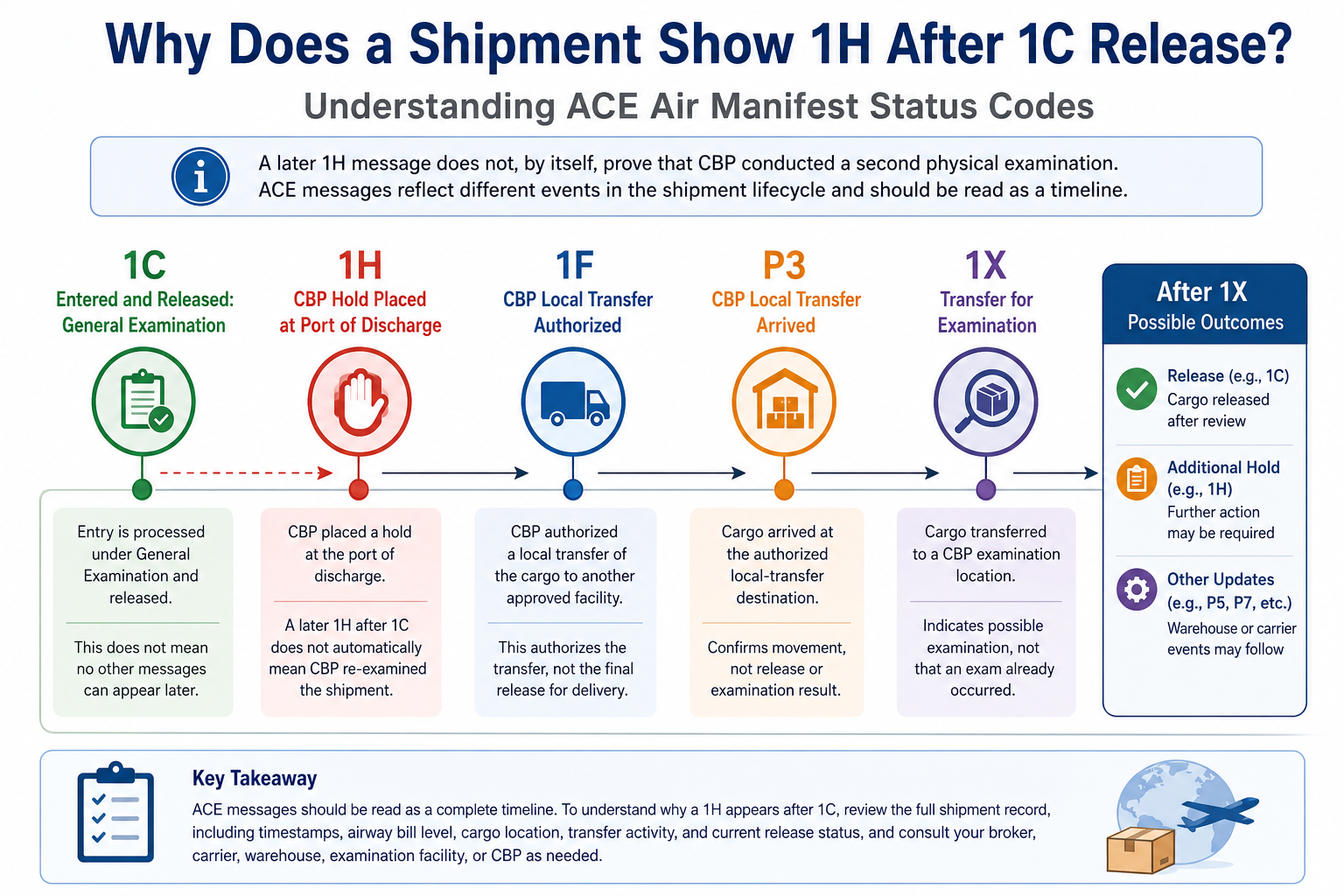
A later 1H message does not, by itself, prove that CBP conducted a second physical examination.
Codes such as 1C, 1H, 1F, P3, and 1X may appear simple when viewed separately. The challenge is understanding what they mean when several messages appear at different times for the same shipment.
One of the most common questions is:
The shipment already showed 1C – Entered and Released: General Examination. Why did a later 1H – CBP Hold Placed at Port of Discharge appear? Does that mean CBP examined the shipment again?
Not necessarily. A later 1H message confirms that a hold event was posted, but the message alone does not prove that a second physical examination occurred. The entire ACE timeline, bill level, cargo location, transfer activity, and current release status must be reviewed together.
ACE Messages Should Be Read as a Timeline
ACE Cargo Manifest Query records different events associated with an air shipment. These events may involve:
- Entry processing
- Manifest control
- CBP holds
- Warehouse custody
- Local transfer authorization
- Arrival at a transfer facility
- Transfer for examination
- Subsequent release or delivery processing
A release message may remain visible in the shipment history even when a later cargo-control or transfer message is added.
For this reason, one code should not be interpreted in isolation. The date, time, air waybill level, and relationship between the messages are all important.
What Does 1C Mean?
1C – ENTERED AND RELEASED: GENERAL EXAMINATION
A 1C disposition generally indicates that the entry was processed under a General Examination status and released.
In practical terms, the cargo completed the CBP General Exam processing associated with that entry message and received a release disposition.
However, an entry release does not necessarily mean that every other operational step has ended. The shipment may still generate later manifest, warehouse, transfer, carrier, or cargo-control messages.
Therefore, 1C should not be interpreted to mean that no additional ACE messages can appear afterward.
What Does 1H Mean?
1H – CBP HOLD PLACED AT PORT OF DISCHARGE
A 1H message means that CBP placed a hold at the port of discharge.
The hold should not be ignored. Before the shipment is delivered or moved, the responsible parties should confirm whether the hold is still active and what action is required.
At the same time, the appearance of 1H after 1C does not automatically prove that CBP physically opened or re-examined the shipment.
Depending on the complete shipment record, the later hold may be associated with:
- Cargo control at the arrival port
- Manifest-level processing
- Local transfer activity
- Movement to a bonded or examination facility
- Port processing requirements
- Another CBP or PGA control event
The reason for the hold must be confirmed through the full ACE record and communication with the broker, carrier, warehouse, examination facility, or CBP.
What Does 1F Mean?
1F – CBP LOCAL TRANSFER AUTHORIZED
A 1F message indicates that CBP authorized a local transfer of the cargo.
This may involve movement from an airline warehouse to another approved bonded facility, such as:
- A container freight station
- A bonded warehouse
- A CES examination facility
- Another authorized transfer location within the port area
The 1F status authorizes the transfer. It does not, by itself, mean that the cargo is available for final pickup or delivery to the importer.
What Does P3 Mean?
P3 – CBP LOCAL TRANSFER ARRIVED
P3 indicates that the cargo arrived at the authorized local-transfer destination.
This is primarily a cargo-movement event. It confirms arrival at the transfer facility, but it does not independently confirm that all customs, PGA, carrier, warehouse, or financial requirements have been completed.
When P3 appears near 1H and 1F messages, it may indicate that part of the ACE history concerns cargo custody and movement between approved facilities.
What Does 1X Mean?
1X – TRANSFER FOR EXAM
In the ACE air environment, 1X indicates a transfer for examination.
It should not be interpreted as Hold Removed.
A 1X message means that CBP initiated or recorded the movement of the air cargo for examination. The message should be reviewed together with any related transfer authorization, arrival notice, cancellation message, examination result, or subsequent release.
Why Can 1H Appear After 1C?
Suppose an ACE query shows the following events:
- 1C – Entered and Released: General Examination
- 1H – CBP Hold Placed at Port of Discharge
- P3 – CBP Local Transfer Arrived
- 1F – CBP Local Transfer Authorized
A reader may assume that the shipment was released, selected for another examination, and then released again.
That conclusion may be incorrect or incomplete.
The codes may represent different layers of the shipment process, including entry release, manifest control, warehouse custody, and local-transfer activity.
The later 1H shows that a hold event occurred, but it does not independently prove that a second physical examination took place.
The correct interpretation depends on:
- The exact timestamps of each message
- Whether the message applies to the MAWB or HAWB
- The shipment location at that time
- Whether a 1X transfer-for-exam message appeared
- Whether the cargo moved to a CES, CFS, or bonded facility
- Whether the hold remained active
- Whether CBP, the carrier, or the broker confirmed another examination
Does 1H After 1C Mean the Cargo Was Examined Twice?
Not necessarily.
A 1H message confirms that CBP posted a hold at the port of discharge. It does not, standing alone, confirm that CBP performed another physical inspection after the 1C release.
Evidence of an actual additional examination may include:
- A 1X transfer-for-exam message
- A new CBP examination notice
- Instructions to move cargo to a CES or examination location
- CES or CFS handling records
- Examination or warehouse charges
- Communication from CBP, the customs broker, or the carrier
- A subsequent examination-completion or release message
Without additional supporting information, it is more accurate to say that a later hold or cargo-control event appeared after the 1C release.
Entry Release Does Not Always Mean the Cargo Is Ready for Pickup
The word “released” is often used to describe several different events:
- CBP entry release
- Manifest release
- PGA release
- Carrier release
- Warehouse release
- Freight-payment release
- Physical availability for truck pickup
These events are related, but they are not identical.
A shipment may have a CBP entry release and still be waiting for:
- Airline breakdown or availability
- Warehouse processing
- Local-transfer completion
- PGA review
- Freight payment
- Storage or examination charges
- Another operational requirement
Therefore, when a broker says that the entry is released, the importer should still confirm whether the cargo is physically available for pickup.
Common Mistakes When Reading ACE Status Codes
1. Reading Only One Status Line
A single code rarely provides the complete shipment history. Always review the full timeline.
2. Assuming Every Hold Means a Physical Examination
A hold restricts movement or release, but the reason and type of hold must be confirmed.
3. Assuming 1C Ends Every Cargo Process
1C is an important entry disposition, but later manifest, warehouse, and transfer messages may still appear.
4. Describing 1X as Hold Removed
In the ACE air environment, 1X means Transfer for Exam. Using the wrong definition can lead to an incorrect interpretation of the entire shipment record.
5. Ignoring the MAWB and HAWB Levels
A status posted at the master-air-waybill level may not fully explain the status of an individual house shipment.
6. Ignoring Message Timestamps
The display order may be affected by transmission timing, system processing, or manual updates. The actual timestamp of each message should be reviewed.
Questions Importers Should Ask
Instead of asking only, “Is my shipment released?”, importers should ask:
- Is the CBP entry released?
- Is there any active CBP or PGA hold?
- Does the hold apply to the MAWB or HAWB?
- Has CBP ordered a transfer for examination?
- Has the local transfer been authorized?
- Has the cargo arrived at the transfer destination?
- Is the cargo physically available at the warehouse?
- Are there any remaining carrier, storage, exam, or freight charges?
- What is the most recent actionable ACE status?
These questions provide a more accurate understanding than relying on a single two-character code.
Conclusion
ACE air manifest disposition codes are valuable, but they must be interpreted as part of a complete shipment timeline.
1C generally reflects an entered-and-released General Examination disposition. 1H indicates that CBP placed a hold at the port of discharge. 1F authorizes a local transfer. P3 confirms arrival at the local-transfer destination. In the ACE air environment, 1X means Transfer for Exam.
Most importantly, the appearance of 1H after 1C does not automatically prove that CBP conducted a second physical examination.
The full chronology, bill level, cargo location, transfer activity, active holds, entry release status, and communications from the broker, carrier, warehouse, examination facility, and CBP should all be considered before reaching a conclusion.
This article is provided for general informational purposes. The status of a specific shipment should be confirmed with the customs broker, carrier, bonded facility, examination facility, or CBP contact responsible for that shipment.