
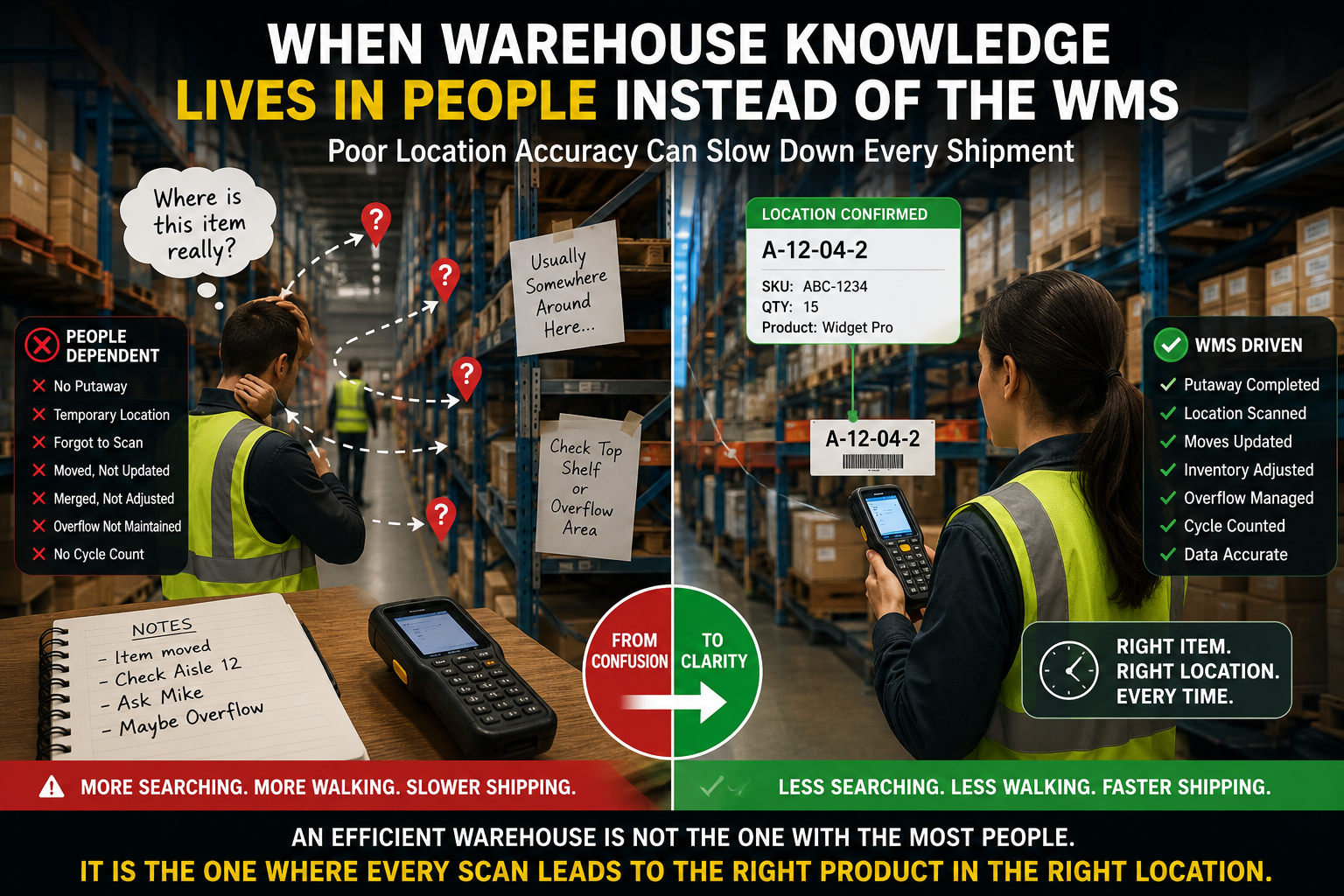
How Poor Location Accuracy Can Slow Down Every Shipment
When the Warehouse Depends on People Instead of the System
A warehouse management system is supposed to provide a reliable answer to a basic operational question:
Where is the inventory?
When a picker scans an order, the WMS should direct the employee to the correct storage location. When the employee arrives, the correct product should be physically available in that location.
However, in many warehouse operations, the physical inventory and the system records gradually stop matching.
The warehouse may continue operating because experienced employees remember where products were actually placed. They may know that a carton shown in one location is physically stored in another aisle. They may remember which temporary location was used during a busy receiving period or which pallets were moved to make additional space.
As long as those employees remain in the warehouse, the problem may not appear serious.
But when the work team changes, employees leave, shifts rotate, or a new labor company takes over, the warehouse may suddenly discover that critical inventory knowledge was never stored in the WMS.
It was stored in people.
What I Observed on the Warehouse Floor
During a recent warehouse visit, I used a handheld scanner to randomly test several storage locations.
I arrived at one location and scanned the location barcode. The WMS showed that the inventory quantity at that location was zero.
However, cartons were clearly sitting on the rack.
I then scanned one of the cartons. The system indicated that the carton should be stored in a different location.
I walked to the location shown in the system, but the carton was not there.
I scanned another carton at that location, and the system pointed to yet another storage location.
The process continued.
Instead of walking directly to one location and picking the required inventory, warehouse employees had to move between multiple locations, scan different cartons, and repeatedly search before they could find the product they actually needed.
The system showed zero inventory where cartons were physically present, while cartons on the rack were assigned to locations where they could not be found.
This is not simply a scanning problem.
It is not only a labor problem.
It is a location accuracy problem, an inventory control problem, and ultimately a warehouse management problem.
How a One-Minute Pick Becomes a Ten-Minute Search
Under normal conditions, a picker should receive a task, walk to the assigned location, scan the product, confirm the quantity, and complete the pick.
The process should be direct and predictable.
When location data is inaccurate, the same task may require:
- walking to the location shown by the WMS;
- discovering that the expected product is not there;
- scanning nearby cartons;
- walking to another location;
- checking additional racks;
- asking experienced employees for help;
- and manually searching until the correct inventory is found.
A task that should take less than one minute may take five, ten, or fifteen minutes.
If this happens once, the impact may appear small.
If it happens fifty times per day, the warehouse may lose several labor hours simply searching for inventory.
If it happens across hundreds of daily orders, it can delay outbound processing, increase overtime, reduce picking capacity, and cause missed carrier cutoff times.
The warehouse may believe it has a labor shortage when the real problem is unreliable inventory data.
Why Does Location Accuracy Break Down?
Location accuracy usually does not collapse because of one major event.
It declines gradually as small exceptions become normal daily practices.
Many warehouse location problems begin with the following situations:
- Inventory is received, but the putaway transaction is not completed;
- Cartons are temporarily placed in an open location;
- Workers forget to scan the product or destination location;
- Inventory is physically moved without updating the WMS;
- Inventory is merged or consolidated without adjusting location records;
- Overflow locations are used but not properly maintained;
- Cycle counts are delayed, incomplete, or not performed.
Each individual situation may appear understandable at the time.
A receiving team may be under pressure to unload a container quickly. The assigned location may be full, so the cartons are placed temporarily in another open location.
The workers may plan to move the inventory later or update the WMS after completing the unloading process.
But the warehouse becomes busy, another truck arrives, outbound orders require attention, and the temporary placement is never corrected.
The product remains physically in the temporary location, while the WMS continues to show the original location.
When this happens repeatedly, the physical warehouse and the system begin operating as two different versions of reality.
Inventory Received Without Completed Putaway
The first major risk occurs during receiving.
Receiving a shipment into the system is not the same as completing putaway.
A product may be received against a purchase order or inbound shipment, but the warehouse must still confirm where the inventory is physically stored.
A complete putaway process should include:
- scanning the carton, pallet, product, or license plate;
- confirming the customer and SKU;
- confirming the received quantity;
- scanning the destination storage location;
- physically placing the product in that location;
- and completing the putaway transaction in the WMS.
If the physical movement is completed but the system transaction is not, the warehouse immediately creates a location discrepancy.
The product exists in the building, but the WMS cannot reliably tell employees where it is.
Temporary Locations Often Become Permanent Problems
Temporary storage is sometimes necessary.
A warehouse may need temporary space because:
- the assigned location is full;
- the receiving team is waiting for customer instructions;
- inventory requires inspection;
- cartons need relabeling;
- the warehouse is experiencing high inbound volume;
- or permanent storage locations are not yet available.
The problem is not the existence of temporary locations.
The problem begins when temporary locations are not controlled.
Every temporary or overflow location should have:
- a clearly assigned location code;
- a defined business purpose;
- a responsible person or team;
- a maximum holding period;
- a required reason code;
- and a process for final putaway or disposition.
Inventory should never be placed in a random open location without a WMS transaction.
If temporary space is not maintained, temporary storage gradually becomes permanent storage, while the WMS continues to show outdated information.
Moving Inventory Without Updating the WMS
Inventory does not remain in the same location forever.
Warehouse workers may move cartons or pallets to:
- create additional space;
- prepare outbound orders;
- separate damaged products;
- organize customer inventory;
- replenish a picking location;
- clear a staging area;
- or improve the physical layout of a rack.
Every physical inventory movement must also become a WMS transaction.
No physical movement should occur without a scan, and every scan should be followed by a completed system confirmation.
If workers move inventory first and plan to update the system later, the update may never happen.
The warehouse then has a product in one physical location and a system record pointing somewhere else.
Inventory Consolidation Must Be Reflected in the System
Inventory consolidation can improve warehouse efficiency.
The same SKU may be scattered across several locations, each containing only a small quantity.
For example:
- Location A-010 contains three cartons;
- Location A-025 contains two cartons;
- Location B-114 contains one carton;
- Location C-040 contains four cartons;
- Location D-008 contains two cartons.
The warehouse may benefit from consolidating this inventory into one primary picking location and one reserve location.
However, physically moving the cartons is only half of the process.
The WMS must also be updated to reflect:
- the source location;
- the destination location;
- the transferred quantity;
- the remaining quantity at the old location;
- the updated quantity at the new location;
- the correct customer ownership;
- and the correct SKU, lot, status, or handling unit.
If employees merge inventory physically but do not adjust the system, the warehouse may create a new problem while attempting to solve an old one.
Consolidation Requires Verification
In a third-party logistics warehouse, products should not be combined simply because the cartons look similar.
Before inventory is merged, the warehouse should verify:
- customer ownership;
- SKU number;
- product description;
- lot number;
- expiration date;
- inventory status;
- damage or hold status;
- serial number requirements;
- purchase order or inbound reference;
- and any customer-specific storage instructions.
Two cartons may contain the same product but belong to different customers, different lots, or different inventory statuses.
Physical appearance alone is not sufficient verification.
Overflow Locations Must Be Managed
Overflow storage is common in busy warehouses.
It becomes necessary when inbound volume exceeds available capacity or when primary locations cannot hold all of the inventory.
Overflow locations can be useful, but only when they are controlled in the WMS.
A warehouse should know:
- which products are stored in overflow;
- how much inventory is stored there;
- which customer owns the inventory;
- why the inventory was moved to overflow;
- when it should be reviewed;
- and whether it should remain there or be moved to a permanent location.
Overflow inventory should be included in cycle counts and location audits.
It should not become a forgotten section of the warehouse.
Cycle Counting Is More Than Counting Total Quantity
Many warehouses believe inventory is accurate when the total quantity in the WMS matches the total physical quantity.
However, quantity accuracy and location accuracy are not the same.
The WMS may correctly show that the warehouse has one hundred cartons of a product.
But if those cartons are physically stored in locations different from the system records, pickers will still be unable to find them efficiently.
Cycle counting should therefore verify both:
- how much inventory exists;
- and exactly where that inventory is located.
A practical cycle-counting program may prioritize:
- high-volume products;
- high-value inventory;
- fast-moving picking locations;
- locations with repeated picking failures;
- system locations showing zero inventory with physical stock present;
- system locations showing inventory but physically empty racks;
- SKUs stored across multiple locations;
- overflow areas;
- recently received inventory;
- and customer accounts with repeated discrepancies.
Cycle counting should become a normal daily warehouse process rather than an emergency activity performed only after a serious problem appears.
Why More Workers Do Not Solve Inaccurate Inventory
When outbound productivity slows down, the first response is often to add more workers.
But more labor does not correct inaccurate WMS records.
If five employees are searching for inventory in the wrong locations, adding another five employees does not necessarily double productivity.
It may simply double the number of people participating in the same inefficient search.
The warehouse may pay for:
- additional walking time;
- repeated scanning;
- manual searches;
- supervisor assistance;
- overtime;
- delayed loading;
- and repeated order exceptions.
The true solution is not always more labor.
Sometimes the solution is better inventory data, stronger location control, and more disciplined warehouse processes.
The Risk of Knowledge Leaving With the Workers
Many warehouses depend on outside staffing companies for picking, putaway, unloading, labeling, and other daily work.
Using temporary or outside labor is not automatically a problem.
The real risk appears when the warehouse does not have a consistent scanning and location-management process.
Workers may gradually learn:
- where incorrectly located products are actually stored;
- which temporary spaces are being used;
- which cartons belong to a particular customer;
- where overflow inventory was placed;
- and which system locations should not be trusted.
This knowledge allows the warehouse to continue operating, but the information exists only in the workers' memories.
When one labor group leaves and another group replaces it, the new team may not know where the products are.
The warehouse then discovers that its real operating system was not the WMS.
It was the experience of a small number of workers.
A well-managed warehouse should not lose inventory knowledge when an employee or labor team leaves.
The Warehouse May Need to Slow Down Before It Can Move Faster
In my opinion, a warehouse facing serious location-accuracy problems may need to temporarily slow down in order to operate faster in the future.
Spending several days reorganizing storage locations, consolidating eligible inventory, reviewing overflow areas, performing cycle counts, and correcting WMS records may reduce outbound speed in the short term.
Customers may still be waiting for shipments, and management may be concerned about reducing daily volume.
However, continuing to process orders with unreliable location data may create an even greater long-term cost.
The warehouse may save several hours today by postponing inventory cleanup, but lose many more hours every day because employees cannot find products.
Once the physical inventory and the WMS are synchronized again, the warehouse can improve:
- picking speed;
- inventory accuracy;
- location accuracy;
- labor productivity;
- order accuracy;
- carrier cutoff performance;
- customer satisfaction;
- and overall operational reliability.
A Practical Warehouse Recovery Plan
Step 1: Stop the Problem From Growing
- Require scanning for every new putaway;
- require WMS confirmation for every inventory movement;
- stop unrecorded inventory consolidation;
- limit the use of uncontrolled temporary locations;
- and assign responsibility for correcting location discrepancies.
Step 2: Identify High-Risk Locations
- Review locations showing zero inventory with physical stock present;
- review locations showing inventory but physically empty;
- identify SKUs stored across many locations;
- review overflow and exception areas;
- and identify products with repeated picking failures.
Step 3: Reconcile the Physical Warehouse With the WMS
- Divide the warehouse into manageable zones;
- scan every storage location in the selected zone;
- scan every carton, pallet, or handling unit;
- confirm the customer, SKU, quantity, and status;
- correct the WMS location record;
- and document any unresolved discrepancy.
Step 4: Consolidate Eligible Inventory
- Combine eligible inventory into fewer locations;
- create primary pick and reserve locations;
- verify customer ownership and inventory attributes;
- complete every transfer in the WMS;
- and confirm the final quantity after consolidation.
Step 5: Maintain the Improvement
- Perform daily cycle counts;
- review overflow locations regularly;
- investigate repeated picking failures;
- train every new worker on scanning requirements;
- and measure location accuracy as a warehouse KPI.
Useful Warehouse Accuracy Measurements
Warehouses should measure more than total inventory accuracy.
Useful performance indicators may include:
- inventory quantity accuracy;
- location accuracy percentage;
- first-location pick success rate;
- average search time for missing inventory;
- number of location corrections per day;
- number of zero-in-system but physically occupied locations;
- number of system-positive but physically empty locations;
- cycle-count variance rate;
- percentage of inventory stored in overflow;
- and number of orders delayed by inventory-location discrepancies.
One of the most useful questions a warehouse can ask is:
When the WMS sends a picker to a location, how often is the correct product actually there?
That result directly affects every outbound shipment.
Final Takeaway
An efficient warehouse is not efficient simply because more people are working inside it.
It is efficient because employees can trust the system.
Every scan should lead the worker to the correct product and the correct storage location.
When warehouse knowledge exists mainly in employees' memories instead of the WMS, the operation becomes vulnerable to labor changes, picking delays, inventory discrepancies, and customer-service problems.
Temporarily slowing outbound activity to reorganize locations, consolidate inventory, maintain overflow areas, perform cycle counts, and correct WMS records may be difficult.
But once the physical inventory and the system accurately match, the warehouse can move faster with fewer searches, fewer errors, and less dependence on individual workers.
An efficient warehouse is not the one with the most workers.
It is the one where every scan leads to the correct product in the correct location.
This article is provided for general warehouse operations and educational purposes only. Every warehouse has different customers, products, systems, labor structures, contractual requirements, and operating procedures. Inventory consolidation, cycle counting, overflow management, and WMS correction procedures should be designed according to the warehouse's specific operational requirements.