
Introduction
During a recent warehouse visit in New Jersey, I noticed an important operational pattern: when shipment volume declines, management weaknesses that were previously hidden by busy activity become much easier to see.
The reason for lower volume may vary. It may involve market conditions, customer demand, seasonality, transportation changes, or an increase in inspections. Without reliable data, it is not appropriate to assume that one factor explains every decline.
However, regardless of the reason, the operational result is often similar. A warehouse may appear less busy, yet employees still spend large amounts of time searching for freight, moving pallets repeatedly, correcting inventory records, and trying to determine who is responsible for the next step.
This does not mean that lower volume creates the management problem. In many cases, the problem already existed. High volume simply made it easier to hide behind overtime, employee memory, temporary floor storage, and informal communication.
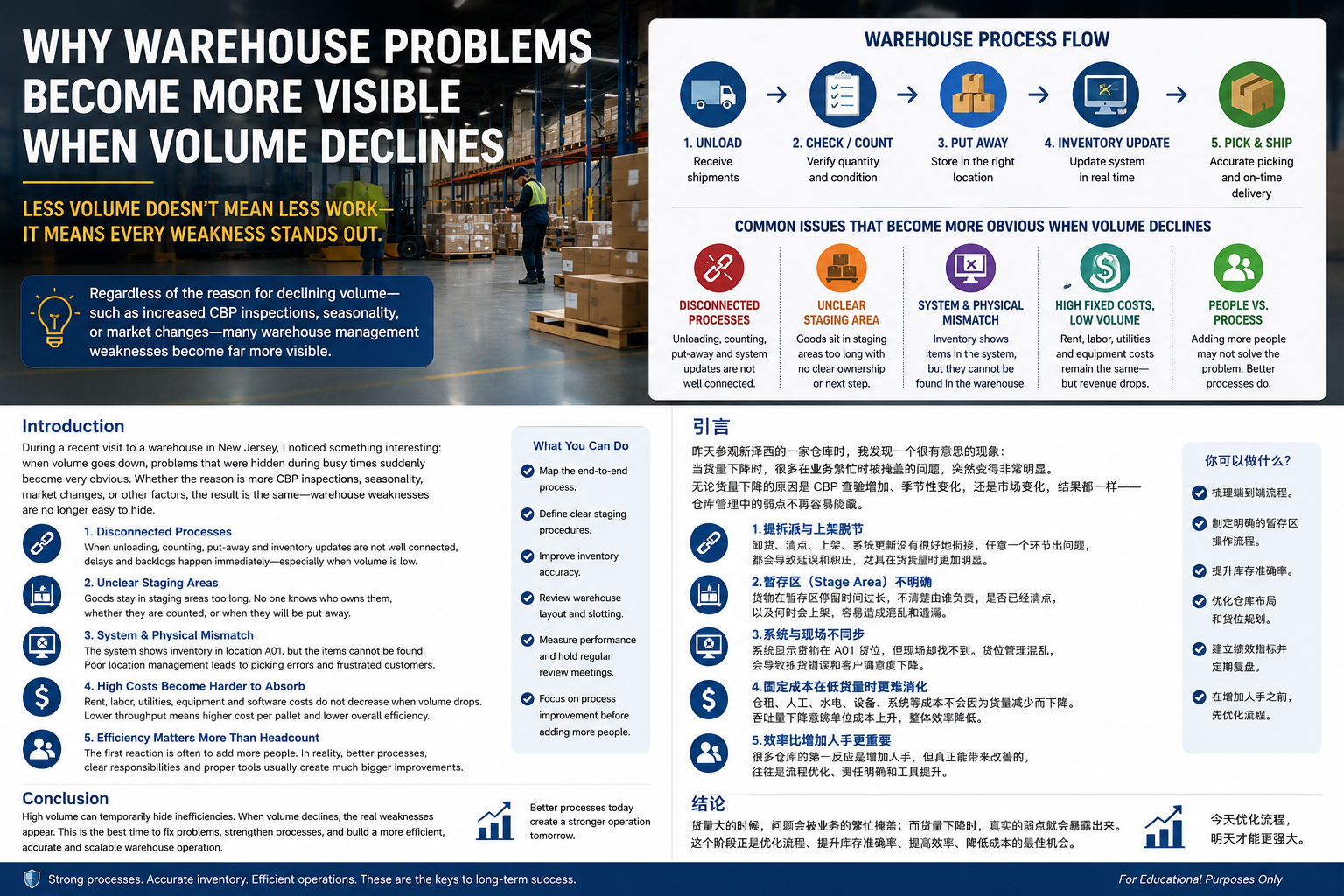
For educational purposes only. The illustration does not identify any specific warehouse, customer, shipment, or company.
1. High Volume Can Temporarily Hide Weak Processes
A busy warehouse often looks productive. Containers are being unloaded, forklifts are moving, employees are opening cartons, and orders are leaving the building.
But visible activity is not always the same as operational control.
When volume is high, employees often rely on personal experience and informal workarounds:
- One employee remembers where a pallet was placed.
- Another employee manually corrects a quantity.
- A supervisor calls several people to locate missing freight.
- Put-away is delayed until there is more time.
- Temporary floor locations are used without being recorded.
These methods may keep the warehouse moving for a short period, but they do not create a reliable process.
When volume declines, the warehouse has more space and fewer orders, yet the same delays, location errors, and unclear responsibilities remain. At that point, it becomes clear that the real issue was not only workload. The process itself was not properly connected.
2. The Warehouse Process Must Be Connected End to End
The image above shows a simple warehouse flow:
Unload
↓
Check and Count
↓
Put Away
↓
Inventory Update
↓
Pick and Ship
Each step depends on the previous step being completed correctly.
If freight is unloaded but not counted, the receiving quantity may be wrong. If it is counted but no storage location is assigned, it may remain in staging. If it is physically moved but the system is not updated, the picker may go to the wrong location. If an order is released before the freight is truly pick-ready, the picking team is forced to solve a receiving problem.
A warehouse does not lose control because of one large mistake. Control is often lost through several small handoff failures.
3. The Most Serious Problem: Freight Remains in the Staging Area
One of the clearest problems in many warehouse operations occurs after ocean freight has been unloaded or broken down.
The cargo is removed from the container or pallet and placed in a temporary staging area. However, it is not put away promptly.
The staging area is supposed to be temporary. It should hold freight only while the warehouse completes a defined next step such as counting, inspection, labeling, location assignment, or put-away.
The staging area becomes a problem when no one can clearly answer:
- When did this freight arrive?
- Which customer or container does it belong to?
- Has it been counted?
- Has damage or shortage been recorded?
- Has a storage location been assigned?
- Who is responsible for the next action?
- When must the freight leave staging?
Without this information, a staging area becomes an unrecorded storage area.
4. A Common Three-Day Warehouse Scenario
Consider a realistic warehouse situation.
On Monday, an ocean container is unloaded. The cargo is broken down and placed in a staging area. Because the put-away team is short-staffed or waiting for instructions, the freight is not moved to final locations.
On Tuesday, another shipment arrives. The new freight is placed near Monday's freight.
On Wednesday, additional cargo arrives. By this time, freight from multiple days, customers, containers, and SKUs is mixed together.
There may be no clear signs showing:
- Monday freight
- Tuesday freight
- Wednesday freight
- Waiting for count
- Waiting for inspection
- Waiting for put-away
- Ready for picking
The warehouse floor may still look organized from a distance, but operational visibility has already been lost.
5. Inventory Exists, but Nobody Can Find It
A few days later, customer orders begin arriving.
The warehouse management system may show that the inventory has been received or is available. The picker goes to the assigned location, but the product is not there.
The goods have not necessarily been lost. They may still be somewhere in the staging area, mixed with freight from several different days.
The warehouse then begins a full search:
- Pickers stop normal picking.
- Supervisors stop managing other work.
- Forklift operators move pallets repeatedly.
- Employees open cartons and compare labels.
- People call one another to ask who last handled the freight.
- Customer orders wait while the search continues.
The problem is not a shortage of inventory. The problem is a failure of receiving, staging, location assignment, and put-away control.
6. Mixed Freight Destroys Warehouse Visibility
When freight from different dates and customers is mixed together, employees cannot quickly determine status or ownership.
This creates several risks:
- Older freight becomes blocked by newer freight.
- Labels are hidden or damaged.
- Similar cartons and SKUs are confused.
- Freight is moved without scanning.
- One customer's goods are placed in another customer's area.
- Orders are picked from temporary locations that are not recorded.
- Inventory accuracy decreases with every uncontrolled movement.
Once employees stop trusting the system, they begin relying on memory. That is the point at which warehouse management becomes reactive rather than controlled.
7. System Inventory and Physical Inventory Must Match
The image identifies a key issue: system and physical mismatch.
The system may display:
Inventory Available — Location A01
But the physical result may be:
Location A01 — Product Not Found
This mismatch can result from:
- Put-away completed physically but not confirmed in the system
- System receipt completed before physical put-away
- Goods placed in an unrecorded temporary location
- Wrong quantities entered during receiving
- Products moved without barcode scanning
- Staging inventory incorrectly treated as available inventory
- Returns or damaged goods not properly separated
The cost is larger than the time spent finding one pallet. Inventory mismatch can lead to delayed orders, wrong shipments, duplicate purchasing, customer complaints, credits, refunds, and loss of confidence.
8. Searching for Freight Is Not a Normal Warehouse Function
In some warehouses, searching for freight gradually becomes accepted as part of daily work.
It should not be considered normal.
A well-managed warehouse should locate freight through:
- Accurate receiving records
- Clear customer and shipment identification
- Defined staging zones
- Barcode scanning
- Correct location assignments
- Timely system updates
If employees regularly spend hours looking for freight, the warehouse is paying labor to compensate for a process failure.
9. Lower Volume Reveals Responsibility Gaps
Delayed put-away often continues because responsibility is unclear.
The unloading team may believe its work ends when freight leaves the container. Receiving may be waiting for paperwork. The put-away team may be waiting for a location sheet. The system operator may be waiting for final quantities.
As a result, everyone is waiting for someone else.
Management should clearly define:
- Who confirms the unloading count
- Who records shortage, overage, and damage
- Who assigns the final location
- Who prints or releases put-away instructions
- Who physically moves the freight
- Who scans and confirms completion
- Who reviews freight that remains in staging too long
Responsibility should be assigned to a role and a deadline, not left to an informal assumption.
10. One Employee Should Not Control the Entire Process
Another common problem is that only one employee can print a location sheet, assign warehouse locations, approve inventory, or complete a key system transaction.
When that person is absent or busy, the entire process stops.
A stronger operation should include:
- Backup employees with appropriate system access
- Written location-assignment procedures
- Cross-training
- Standard rules for common freight types
- Escalation procedures for exceptions
Operational knowledge should belong to the organization, not remain with one individual.
11. Fixed Costs Become Harder to Absorb When Volume Declines
Warehouse costs do not fall at the same speed as shipment volume.
The warehouse must still pay for:
- Rent
- Utilities
- Insurance
- Equipment
- Maintenance
- Software
- Management and administrative labor
When volume is high, these costs are spread across more shipments. When volume declines, the cost per shipment increases.
If employees also spend more time searching, moving, correcting, and reworking freight, the warehouse becomes less profitable even though it appears less busy.
12. Efficiency Matters More Than Headcount
The first response to warehouse delays is often to add more people.
But more people do not automatically create a better process.
If employees are waiting for one person to print a document, the issue is not headcount. If inventory cannot be found because locations are inaccurate, more employees may simply create more searching.
Before hiring additional labor, management should ask:
- Is the process clearly documented?
- Does every employee know the next required step?
- Are staging zones clearly marked?
- Are location assignments available on time?
- Are system updates completed in real time?
- Are employees measured on completion and accuracy?
Better processes, clear responsibilities, and proper tools often produce greater improvement than simply adding labor.
13. What Warehouse Operators Can Do
The image recommends several practical actions. These can be expanded into a clear improvement plan.
Map the End-to-End Process
Document every step from vehicle or container arrival through receiving, counting, staging, put-away, inventory confirmation, picking, and shipping.
Define Clear Staging Procedures
Create separate, clearly marked zones for:
- Waiting for count
- Waiting for inspection
- Waiting for put-away
- Problem or exception freight
- Ready for outbound movement
Use Visible Status Identification
Each pallet or cargo group should display:
- Customer name or code
- Container, shipment, or receiving reference
- Arrival date and time
- Quantity
- Current status
- Next required step
- Responsible employee or team
Set a Put-Away Deadline
Management should establish a measurable target, such as same-shift put-away or completion within a defined number of hours after receiving.
Improve Inventory Accuracy
Use scanning, cycle counts, location audits, and investigation of repeated errors. Staging freight should not be shown as fully available unless the business process clearly supports that status.
Review Layout and Slotting
Fast-moving products should be placed in accessible locations. Floor storage, rack capacity, aisles, and staging zones should support the actual flow of goods.
Measure Performance
Useful measurements include:
- Time from unloading to receiving confirmation
- Time from receiving confirmation to put-away
- Percentage put away within target time
- Number of staging items older than one shift or one day
- Orders delayed because inventory could not be located
- Inventory accuracy by location
- Labor hours spent on searching and rework
Focus on Process Before Adding People
Labor should support a defined process. It should not replace one.
14. Lower Volume Can Be an Improvement Opportunity
A slow period is difficult for any warehouse, especially when fixed costs remain high.
However, it can also provide time to solve problems that were difficult to address during peak periods.
Management can use lower volume to:
- Remove old freight from temporary areas.
- Correct inaccurate locations.
- Redesign staging zones.
- Write or update SOPs.
- Cross-train employees.
- Review system permissions.
- Measure put-away time.
- Perform cycle counts.
- Investigate repeated order delays.
- Prepare the warehouse for future growth.
When volume returns, a warehouse with stronger processes will be able to handle growth without repeating the same confusion.
Conclusion
High volume can temporarily hide warehouse inefficiencies. When volume declines, the real weaknesses become easier to see.
Disconnected processes, unclear staging areas, system and physical inventory mismatches, high fixed costs, and inefficient labor use are not created by lower volume. They are exposed by it.
The warehouse management goal should not be to become better at finding freight after it has been misplaced.
The goal is to build a process that prevents freight from becoming difficult to find in the first place.
Better processes today create a stronger, more accurate, and more scalable warehouse operation tomorrow.
This article is provided for general educational and industry-information purposes only. It does not identify or evaluate any specific warehouse, company, customer, employee, or shipment.