
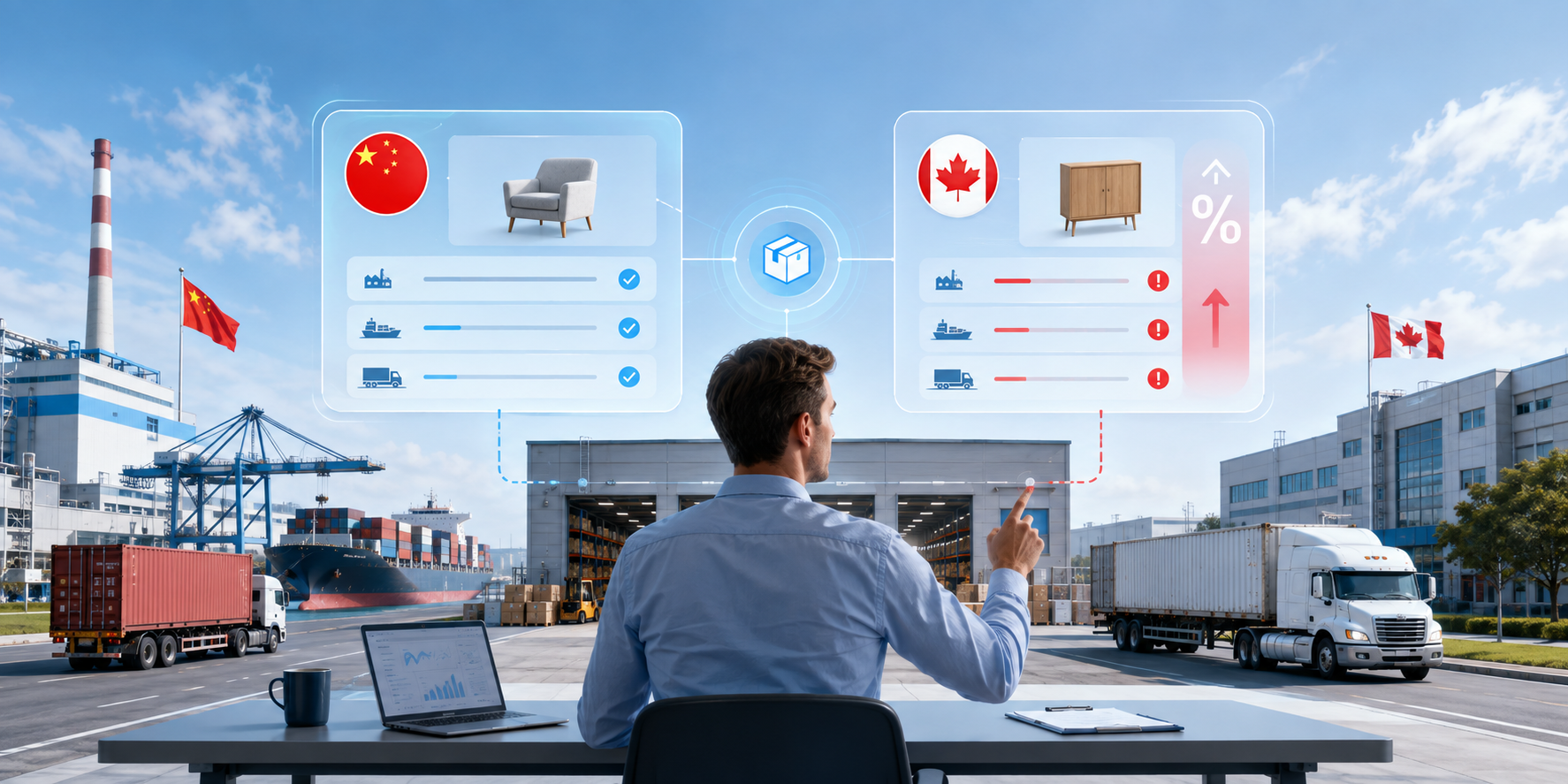
When a new tariff is announced, the first question for many Chinese manufacturers is simple: Will this make it harder—or easier—to sell products to the United States?
The latest U.S.–Canada tariff dispute requires a careful answer.
In July 2026, the United States announced an additional 50 percent tariff on nearly $20 billion of selected Canadian-origin products. After a short postponement, the new duties took effect on August 22, 2026. The covered products include selected Canadian goods identified in the official tariff annexes.
But this action does not directly impose a new tariff on products of China.
If a product is manufactured in China and shipped directly to the United States, it continues to be treated under the tariff rules that already apply to Chinese-origin goods. Depending on the product, those rules may include the normal duty rate, Section 301 tariffs, Section 232 measures, antidumping or countervailing duties, and other applicable trade actions. The new Canada measure does not automatically add another 50 percent tariff to that Chinese product.
The effect on Chinese factories is therefore not a direct tariff change. It is a possible change in sourcing decisions.
When Chinese Manufacturers May Gain
Suppose a U.S. importer currently purchases a covered product from Canada. If the Canadian product becomes subject to an additional 50 percent tariff, its landed cost may rise sharply.
The importer may then compare alternative sources in the United States, China, Mexico, Vietnam, India, or other markets.
A Chinese product may already be subject to U.S. tariffs. But if its factory price and total landed cost remain lower than the newly taxed Canadian product, the Chinese supplier may become competitive again.
For example, a Canadian product priced at $100 could approach $150 before other import costs after a 50 percent additional tariff. A comparable Chinese product might have a lower factory price and its own applicable duties. If the Chinese product's final landed cost is still below the Canadian alternative, the U.S. importer may consider shifting orders.
This does not mean Chinese products have received a tariff reduction. It means a Canadian competitor may have become more expensive.
The opportunity will be product-specific. A Chinese manufacturer must still confirm:
- The product's HTS classification;
- The normal U.S. duty rate;
- Whether Section 301 or Section 232 applies;
- Whether antidumping or countervailing duties apply;
- Product safety and other agency requirements; and
- Total landed cost, including freight, brokerage, examinations, storage and domestic delivery.
When Chinese Manufacturers May Lose
The same tariff dispute can also hurt some Chinese suppliers.
Many Canadian manufacturers purchase components, packaging, equipment, or raw materials from China and then export finished goods to the United States. If the Canadian finished product becomes too expensive in the U.S. market, the Canadian manufacturer may lose orders and reduce production.
That reduction can flow back to its Chinese suppliers.
China supplies components → Canada manufactures the finished product → the finished product is exported to the United States.
If U.S. demand for the Canadian finished product falls, the Chinese component supplier may also receive fewer orders. In this situation, the Chinese factory is not directly taxed by the new U.S.–Canada measure, but it is indirectly affected through its Canadian customer.
Could China Gain Business in Canada?
Canada continues to maintain counter-tariffs on selected U.S. steel, aluminum, and automobiles. When U.S. products become more expensive in Canada, some Canadian importers may look for alternative suppliers.
Chinese manufacturers could be considered in certain product categories. However, Canada also maintains its own trade measures on selected Chinese electric vehicles, steel, aluminum, and other covered products. Therefore, China is not automatically the lowest-cost replacement.
Again, the decision depends on the specific product and its landed cost in Canada.
Country of Shipment Is Not Country of Origin
A Chinese product does not become Canadian simply because it is stored, repacked, labeled, or shipped from a Canadian warehouse.
If a Chinese-origin product moves through Canada and is then imported into the United States, U.S. Customs will generally examine where the product was actually manufactured and whether any processing in Canada was sufficient to change its origin.
Simple transshipment does not normally erase the tariffs applicable to Chinese-origin goods. At the same time, a Chinese product should not automatically be treated as Canadian-origin merely because Canada was the country of shipment.
The correct tariff treatment depends on legal origin, classification and the applicable tariff provisions—not only the transportation route.
What U.S. Importers and Chinese Factories Should Do
The new U.S.–Canada tariffs create a reason to recalculate sourcing costs, not a reason to assume that China has automatically won or lost.
U.S. importers should compare suppliers using total landed cost rather than factory price alone. Chinese manufacturers should prepare accurate product descriptions, HTS information, material composition, country-of-origin support, and realistic freight and delivery costs.
The most useful question is not simply, What is the tariff rate? It is:
After all duties, transportation, customs processing, compliance, inventory and delivery costs are included, which supply source produces the best total result?
The Bottom Line
The new U.S. tariffs on selected Canadian products do not directly add a new tariff to Chinese goods entering the United States.
- Some Chinese factories may gain replacement orders when Canadian products become more expensive in the United States.
- Some Chinese suppliers may lose orders when Canadian manufacturers reduce production.
- Chinese factories may find selected opportunities in Canada when U.S. products become more expensive, but Canadian tariffs on China must also be checked.
The result will not be the same for every industry. The winners will be the suppliers and importers that calculate product-specific landed cost before changing their supply chain.
This article provides general trade and supply-chain information and is not legal or customs advice. Tariff treatment depends on classification, origin, entry date and applicable exclusions or relief.