
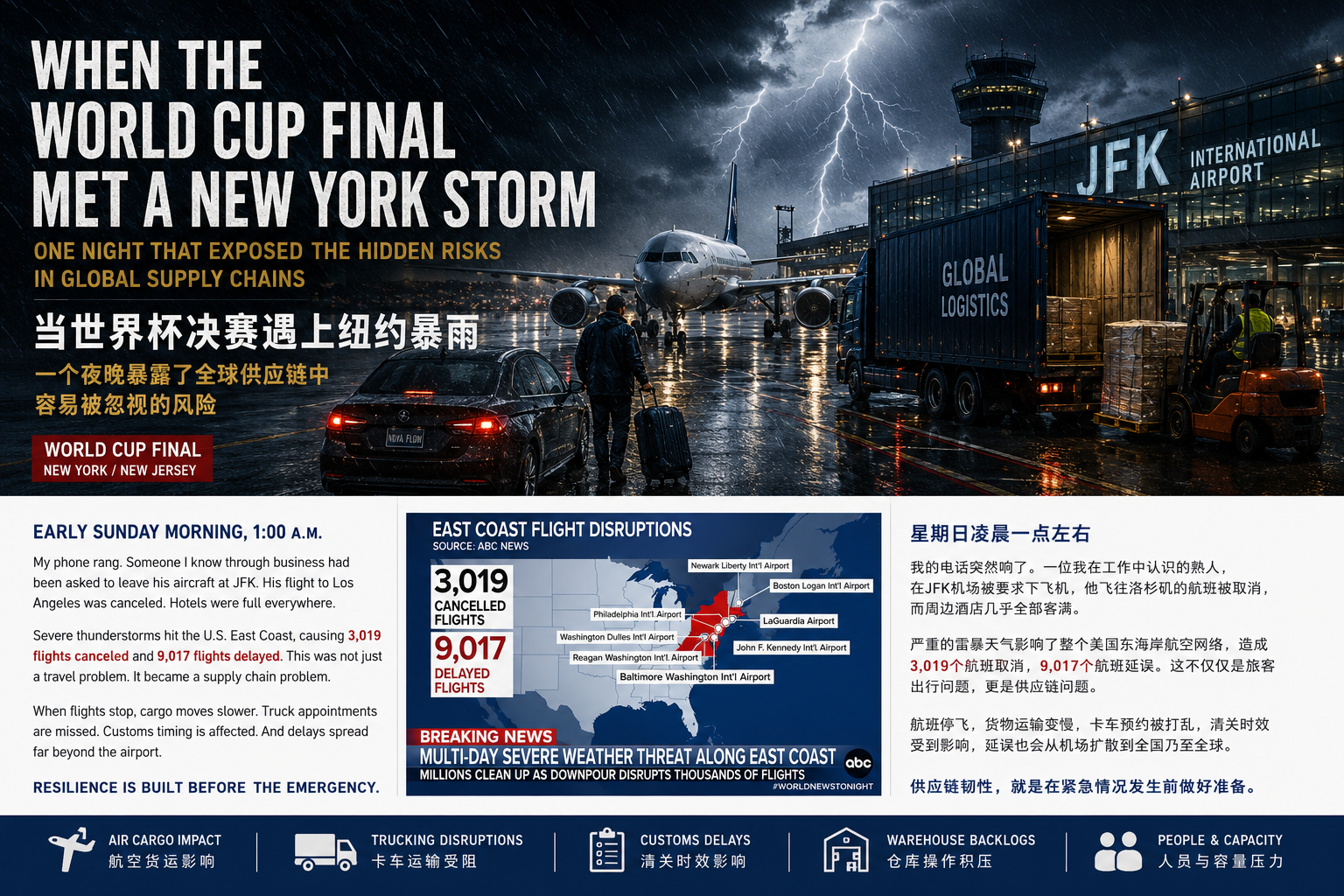
Early Sunday morning, at around 1:00 a.m., my phone rang.
Someone I know through business had been scheduled to fly from New York's John F. Kennedy International Airport to Los Angeles. He had already boarded the aircraft, taken his seat and fallen asleep.
When airline employees woke him, he initially thought the plane had arrived at Los Angeles International Airport.
It had not.
The aircraft had never left JFK.
Severe thunderstorms had disrupted airport operations across much of the U.S. East Coast, not just at JFK Airport. Thousands of flights were delayed or canceled, creating a chain reaction throughout the aviation network.
The flight was canceled, and all passengers were told to leave the aircraft.
He called me and asked whether I could drive around the airport area and help him find a hotel with an available room.
At first, this may sound like a simple passenger travel story. But what happened that night revealed something much larger about transportation networks and global supply chains.
East Coast Aviation Disruption
3,019 flights were canceled, and 9,017 flights were delayed.
Major airports affected included JFK, LaGuardia, Newark, Boston Logan, Philadelphia, Washington Dulles, Reagan National and Baltimore/Washington.
This was not an isolated airport incident. It was a regional transportation disruption.
It Was Not About the Price
I began searching around JFK Airport, LaGuardia Airport, Flushing and the surrounding neighborhoods.
The problem was not simply that hotel prices were high.
The real problem was that there were almost no rooms available at all.
Many passengers from canceled and delayed flights were searching for accommodations at the same time.
It was also the weekend of the World Cup Final in the New York and New Jersey region. Hotels, flights, restaurants and ground transportation were already experiencing unusually high demand.
The World Cup did not cause the storm or the flight cancellations. However, a major international event reduces the amount of spare capacity available across a city.
When severe weather and widespread transportation disruptions occur at the same time, the system has much less room to absorb the shock.
After driving around and checking several locations, we finally found an available room at a small hotel.
By Sunday morning, the rain had stopped and the weather had turned sunny. But the disruption did not end when the sky cleared.
Travelers were still competing for limited seats on replacement flights. The next available flight he could secure to Los Angeles was not until Wednesday.
This Was More Than a Passenger Travel Problem
Passenger inconvenience is the most visible consequence of a major airport disruption, but it is only one part of the story.
Modern aviation networks carry both passengers and cargo. A significant amount of air cargo moves in the lower-deck cargo compartments of scheduled passenger aircraft.
When passenger flights are canceled, cargo booked on those aircraft may also be delayed, rerouted or moved to a later flight.
One canceled flight can therefore affect:
- Passengers and airline crews
- Time-sensitive air cargo
- Airport cargo warehouse operations
- Truck pickup and delivery appointments
- Customs brokers and freight forwarders
- Importers waiting for inventory
- Exporters working against delivery deadlines
- E-commerce sellers promising rapid fulfillment
- Hotels, taxis and ground transportation providers
The effects do not remain inside one airport. They move across the region and through the entire transportation network.
How a Regional Airport Disruption Reaches the Supply Chain
1. Air Cargo Capacity Disappears
When a passenger aircraft does not depart, its available lower-deck cargo capacity disappears with it.
Shipments may have to wait for the next available flight or be transferred to another airline or airport.
2. Alternative Airports May Also Be Disrupted
During a regional weather event, changing airports may not immediately solve the problem.
JFK, LaGuardia, Newark, Philadelphia, Boston and Washington-area airports may all be affected at the same time. A route that normally serves as a backup may also be operating under restrictions or severe delays.
3. Cargo Arrivals Become Unpredictable
A shipment expected to arrive Saturday night may not arrive until Sunday, Monday or even later.
This affects warehouse staffing, trucking schedules, cargo availability notices and customer delivery commitments.
4. Truck Appointments Are Disrupted
A trucker may arrive at an airport cargo facility only to discover that the shipment has not landed, has not been unloaded or is not yet available for pickup.
The carrier may lose hours waiting, and a new pickup appointment may be required.
5. Customs and Physical Cargo Status Become More Complicated
Bad weather does not necessarily stop electronic customs processing, but it can delay the physical arrival, unloading, transfer and availability of cargo.
A shipment may have received customs release while still being unavailable at the airline warehouse.
Conversely, cargo may have arrived but remain unavailable because operational backlogs have delayed breakdown, warehouse processing or documentation.
Customs release and physical cargo availability are related, but they are not the same thing.
6. Delays Spread Across the Aviation Network
An aircraft does not operate only one route.
When a flight is canceled in New York, the aircraft and crew may also be unavailable for their next scheduled flight.
The result can be additional delays in Los Angeles, Chicago, Miami or another city far from the original storm.
7. People Become Part of the Supply Chain Disruption
Pilots, flight attendants, truck drivers, warehouse employees, operational personnel and business travelers may all require transportation and accommodations.
When nearby hotels are full, displaced crews and essential workers may not be able to rest or report for their next assignment on time.
During a major disruption, hotels become part of the transportation system's emergency support capacity.
What the World Cup Teaches Us About Capacity
Major international events create extraordinary economic activity, but they also place extraordinary pressure on local infrastructure.
During a major event such as the World Cup, demand increases for flights, hotel rooms, taxis, restaurants, security personnel, warehouses, temporary storage, last-mile delivery and retail inventory.
Most transportation systems are designed around expected demand. They may operate efficiently under normal conditions but have limited spare capacity during major events.
When severe weather occurs, the remaining capacity can disappear very quickly.
This is the hidden risk: a system may appear strong when everything is operating normally, yet become extremely fragile when several pressures arrive at the same time.
Lessons for Importers, Exporters and Logistics Companies
Build Additional Time Into Critical Shipments
Do not plan time-sensitive shipments on the assumption that every flight, warehouse transfer and truck appointment will operate exactly as scheduled.
Identify Multiple Alternative Routes
A backup plan should include more than one alternative airport. A regional storm may affect several gateways simultaneously.
Monitor More Than the Weather
Logistics teams should monitor airport operating conditions, airline flight status, cargo warehouse availability, air traffic delay programs, local road conditions, truck appointment capacity and major events in origin and destination cities.
A sunny forecast the following morning does not mean the transportation backlog has disappeared.
Communicate Before Customers Ask
A useful update should explain what happened, where the cargo is located, whether customs clearance has occurred, whether the shipment is physically available and when another update will be provided.
Maintain a Practical Contingency Plan
A practical plan may require backup trucking companies, alternative airport warehouses, after-hours contacts, flexible delivery appointments, additional safety stock and clear responsibility for customer communication.
Resilience Is Built Before the Emergency
Early Sunday morning, the immediate problem was finding one hotel room for one stranded traveler.
But the larger lesson extended far beyond that room.
The same regional storm that prevented a passenger from reaching Los Angeles could also prevent cargo from reaching a warehouse, a truck from meeting its pickup appointment, an airline crew from operating its next flight or an importer from fulfilling a customer order.
The World Cup Final lasted about 90 minutes. The most severe weather lasted only a few hours. But the disruption to travelers, cargo and supply chains continued for days.
Global supply chains do not fail only because of one major catastrophe.
Sometimes they fail because several ordinary pressures—a major international event, severe regional weather, limited hotel capacity, full flights and tightly scheduled operations—arrive at exactly the same time.
Resilience means preparing for that moment before the phone rings in the middle of the night.