
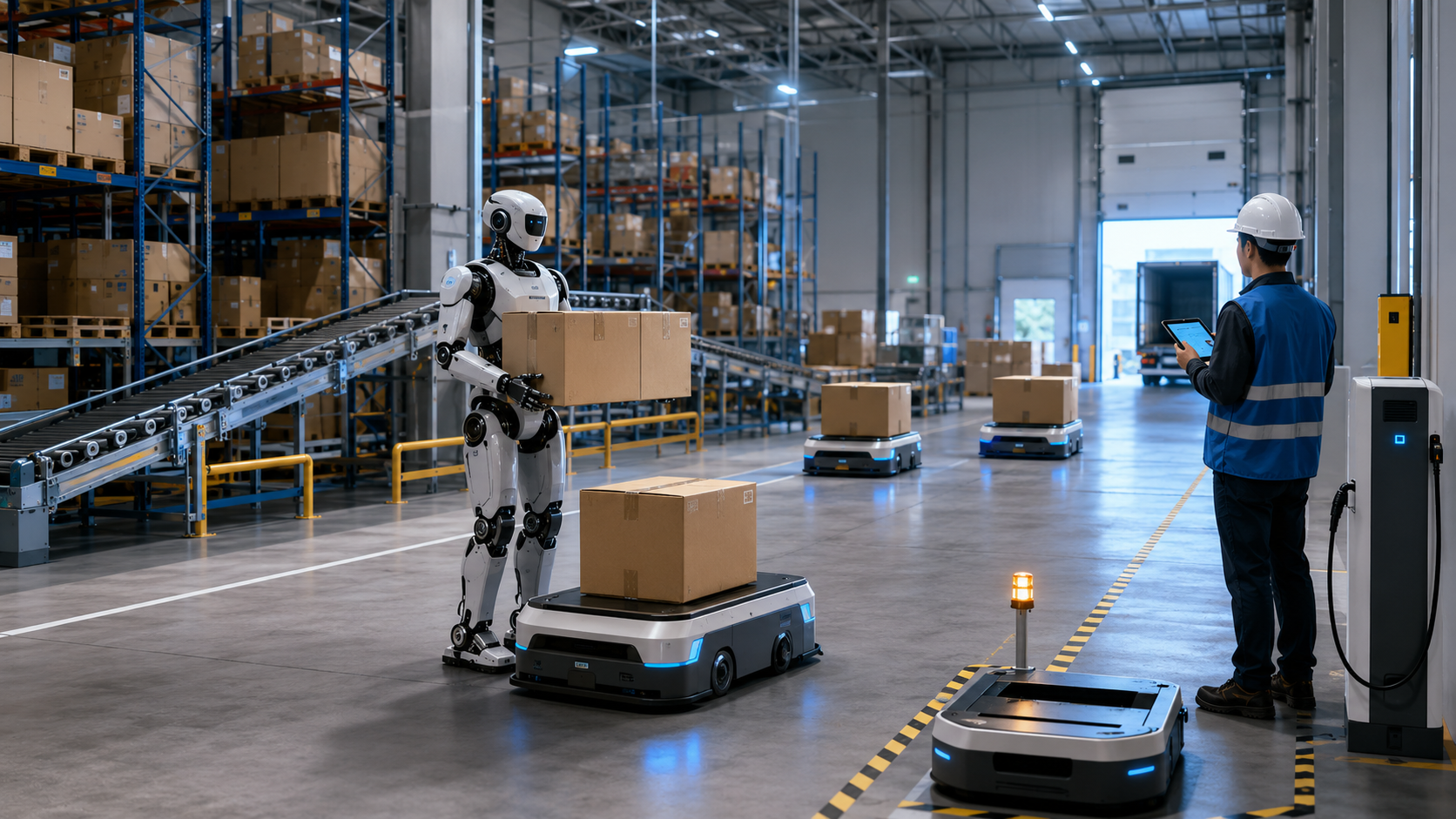
Robots can dance, run and perform on a stage. But can they unload a truck, sort thousands of parcels and work safely beside warehouse employees?
That is the question logistics companies should ask after the World Robot Conference 2026. Held in Beijing from August 19 through August 23, WRC 2026 brought together more than 300 exhibitors and more than 2,000 robotic products. The conference highlighted humanoid robots, autonomous mobile robots, machine vision and embodied intelligence. For warehouse operators and cross-border e-commerce sellers, however, the most important issue is not the performance on the exhibition floor. It is whether these systems can reduce the real cost of receiving, storing, picking, packing and shipping an order.
Where Warehouse Robots Can Create Value
Robots are most effective when work is repetitive, measurable and performed at sufficient volume. Autonomous mobile robots can move cartons between receiving, storage and packing areas. Robotic arms can palletize standardized cases. Machine-vision systems can scan labels, count inventory and detect packaging problems. These applications may provide several benefits:
- Lower repetitive labor requirements: Robots can take over physically demanding tasks such as moving cartons, transporting totes and stacking cases.
- More consistent accuracy: Barcode scanners and vision systems can reduce mis-picks, incorrect labels and inventory discrepancies.
- Longer operating hours: Automated equipment can support evening and overnight operations, although charging, maintenance and supervision are still required.
- Improved workplace safety: Robots can handle heavy loads and repetitive movements that may contribute to employee injuries.
- Scalability during peak seasons: Well-designed automation can help a fulfillment center process a higher order volume without increasing labor at the same rate.
The Hidden Costs Behind Automation
A robot does not eliminate cost. It changes the type of cost. A proper analysis must include the purchase or lease price, installation, warehouse modifications, electricity, charging stations, replacement batteries, software subscriptions, system integration, maintenance, insurance and the financial effect of downtime.
Electricity is a real expense, especially when a warehouse operates multiple robots, servers, cameras, wireless networks and climate-control systems. Battery performance also declines over time. Nevertheless, electricity should not be compared with wages alone. A complete comparison should consider wages, benefits, overtime, training, turnover, injuries and the cost of human errors on one side, and the total ownership and operating cost of automation on the other.
For a high-volume facility with stable processes, automation may lower the cost per order. For a small warehouse with irregular products or limited daily volume, the same technology may increase costs and create unnecessary complexity.
What Happens When a Robot or System Fails?
The realistic risk is usually not a science-fiction robot suddenly becoming violent. More common risks include sensor errors, incorrect barcode readings, damaged cartons, network interruptions, software defects, battery overheating, inaccurate warehouse-management-system data and unauthorized access to connected equipment.
A highly automated facility can also create a concentration of risk. If one employee stops working, the rest of the warehouse may continue. If the central control system fails, an entire conveyor or picking process may stop. A single incorrect inventory instruction can place hundreds of products in the wrong locations before the problem is discovered.
Responsible deployment therefore requires emergency-stop controls, speed limits, collision detection, protected work zones, access controls, activity logs, cybersecurity monitoring and a trained employee who can take over. Warehouses should also maintain manual backup procedures, redundant network or power arrangements and a method for isolating a failed robot without shutting down the entire operation.
Not Every Product Is Robot-Friendly
Automation works best with standardized cartons, totes and pallets. Soft bags, liquids, glass, oversized freight, irregular shapes and easily damaged products remain more difficult to identify and handle. Cross-border e-commerce warehouses often process thousands of SKUs from different suppliers, with inconsistent packaging and incomplete product data. That variation can reduce the expected return on a robotic system.
How Robotics Could Affect Cross-Border E-Commerce
For cross-border sellers, robotics can accelerate receiving, order fulfillment and returns processing. AI systems can help predict order volume, optimize storage locations and check package dimensions and shipping labels. Faster and more accurate fulfillment may reduce late shipments, platform penalties, customer complaints and returns.
However, automation also increases dependence on data. A system connected to Amazon, Walmart or another marketplace can process an incorrect instruction at scale. An inaccurate product description, country of origin, inventory status or shipping label can quickly affect many orders. AI may assist with tariff classification and import-document preparation, but it does not assume legal responsibility. The Importer of Record and other responsible parties must still verify customs information and regulatory requirements.
Chinese Robots Entering the U.S. Market
Robots and automation equipment moving from China to the United States also create traditional logistics and compliance questions. Importers must review HTS classification, customs value, country of origin and the identity of the Importer of Record. Equipment containing lithium batteries or wireless communication functions may require additional transportation documents or regulatory review. Spare parts, batteries and the complete robot may also require different classifications.
The technology may be new, but the basic principle remains familiar: faster equipment does not remove the need for accurate documents, responsible importers and a compliant supply chain.
The Practical Question Is Cost per Order
Logistics companies do not need to begin with a humanoid robot. Many can obtain a better return by first improving barcode controls, inventory data, route planning, dimension measurement, machine vision or semi-automated sorting. Automation should solve a clearly measured operational problem rather than simply follow a technology trend.
The winning robots will not necessarily be the ones that perform best on stage. They will be the ones that can safely, accurately and repeatedly complete thousands of ordinary warehouse tasks while lowering the total cost of each order.
This article provides general industry information and does not constitute customs, legal, tax or safety advice. Companies should evaluate their products, facilities and regulatory responsibilities with qualified professionals.